Cuba grants 8-year tax exemption for renewable energy investments
New resolution eliminates customs duties and grants 8 years tax-free for those investing in solar, wind, or biodigesters in Cuba.
3 min read
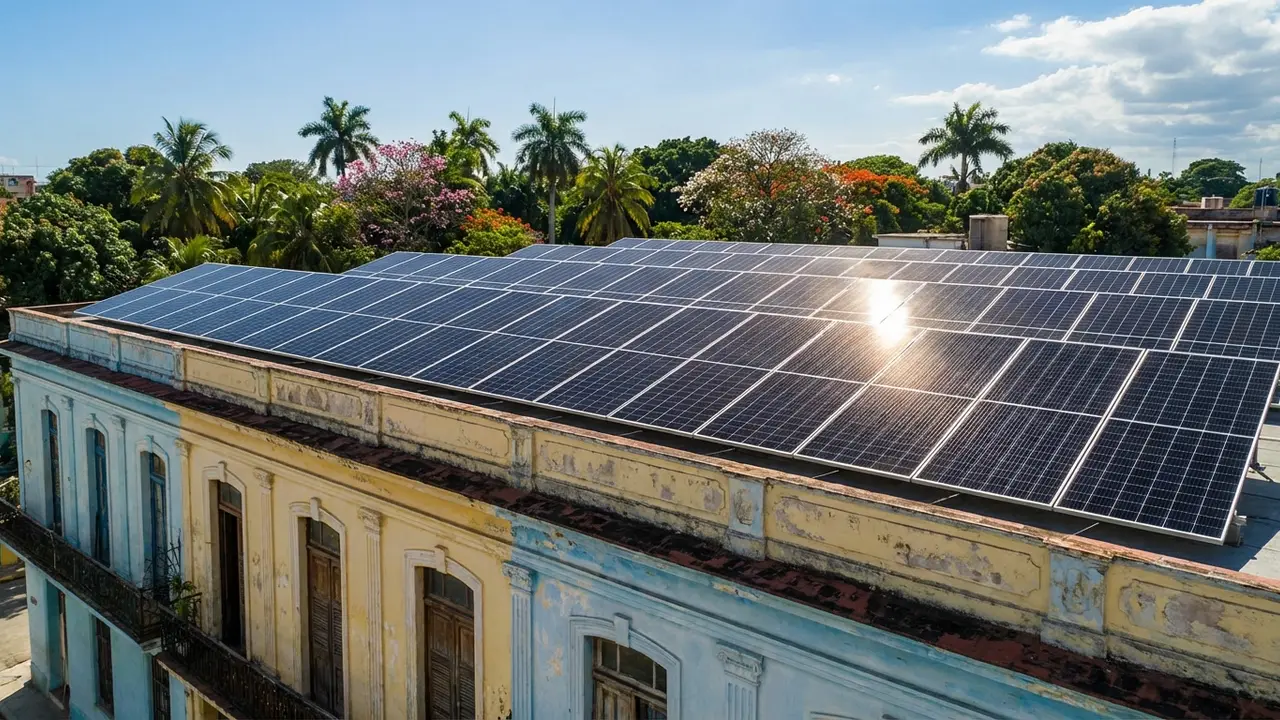
Illustration: Aroma de Cuba (AI)
The Cuban government approved on Thursday one of the most ambitious economic measures in recent years: up to eight years of tax exemption for individuals and legal entities investing in renewable energy systems, according to Resolution 41/2026 of the Ministry of Finance and Prices, published in the Official Gazette.
The regulation, effective immediately, also eliminates Customs Duty for importing solar panels, inverters, batteries, and other renewable system components—a radical change in a country where imports have historically been heavily taxed.
Exemption of up to 8 years based on investment
Taxpayers investing in renewable generation technologies will be exempt from Corporate Income Tax (for businesses) or Personal Income Tax (for individuals) during the period necessary to recover the investment, with a maximum limit of eight years.
The benefit is not automatic: it requires an energy certification issued by the competent authority verifying the installed system’s operation, and filing an application with the National Tax Administration Office (ONAT). The tax administration may revoke the benefit if non-compliance is detected.
No tariffs on panels, batteries, and inverters
The resolution significantly expands the list of equipment exempt from Customs Duty:
- Complete photovoltaic solar systems
- Solar panels, inverters, batteries, and transformers
- Controllers, support structures, and specialized wiring
- Solar heaters and photovoltaic pumps
- Small-scale wind turbines
- Biodigesters and associated equipment
For individuals, these goods will not count within the non-commercial import limit, provided they are presented separately to Customs and comply with current technical regulations.
Electric vehicles and their components are expressly excluded from these benefits.
Controlled prices and grid connection
The resolution establishes that renewable technologies must be sold at non-tax prices, based on costs and expenses with a limited profit margin, to prevent speculation and facilitate access.
Additionally, the regulation allows those installing generation systems to deliver energy to the National Electric System (SEN), opening the door to grid connection schemes that allow selling surplus energy, a topic the regime had previously announced.
Energy crisis as driver of change
The measure comes amid an unprecedented energy crisis in Cuba, marked by prolonged blackouts exceeding 12 hours daily in several provinces and a structural fuel deficit that has led the government to drastically ration thermal generation.
In January 2026, Cuba received no imported oil for the first time in a decade, and analysts estimate strategic reserves would be depleted by late March if new shipments don’t arrive.
The government, which has historically controlled all electricity generation in the country, now seeks to decentralize production and reduce dependence on fossil fuels through private renewable investments—a pragmatic shift given the current model’s unsustainability.
A paradigm shift in economic policy
For Cuban economist Pavel Vidal, consulted by CiberCuba, the resolution represents “a paradigm shift in the country’s economic policy, which for decades viewed the private sector with distrust and now needs it to solve critical infrastructure problems.”
The eight-year exemption is also one of the most generous in Latin America for renewable energy, surpassing even incentives in countries like Costa Rica (5 years) or the Dominican Republic (6 years).
Questions remain about financing mechanisms—most Cubans lack access to hard-currency bank credit—and the actual availability of equipment in the local market, still constrained by the U.S. embargo and import restrictions.
But the signal is clear: Cuba is betting on renewable energy as an escape route from its worst energy crisis in 30 years, and is willing to cede fiscal control to the private sector to achieve it.
Frequently asked questions
What tax benefits does Cuba offer for renewable energy?
Who can access these tax exemptions?
Which equipment is exempt from import tariffs?
Why is Cuba adopting this policy now?
How we got here
Background
The first thing we published on this topic.
US Diplomat: 'Cuban Regime Won't Survive 2026'
Mike Hammer, head of the US mission in Havana, says the Cuban government faces a critical moment and sends message of hope to the people.
Cuban Government Promises Pensions Despite Energy Crisis
Finance Minister assures pensions are guaranteed in 2026 budget, while acknowledging partial increase 'doesn't fully solve' retirees' situation.
Related articles
Prison Riot in Cuba's Canaleta Leaves at Least Seven Dead
Inmates at the high-security Canaleta prison in Ciego de Ávila rioted over hunger and abuse. NGOs report seven killed in police crackdown.

Cuba to End Product Subsidies in Ration System Starting April 2026
Cuba announces a historic shift: from April, the government will subsidize vulnerable people directly, transforming the 60-year-old ration book.

French and Cuban Foreign Ministers Meet in Paris Amid Tense Context
Jean-Noël Barrot and Bruno Rodríguez discussed human rights, Cuba's crisis, and US threats in Paris on February 20. Europe is carving out its own space.
Federal Court: Third-Country Deportations Violate Constitution
Massachusetts judge blocks Trump policy deporting Cubans to countries they weren't born in, ruling it violates due process rights.

Cuban Dissident Influencers from El4tico Held in Provisional Prison
Ernesto Ricardo Medina and Kamil Zayas, creators of El4tico, face charges of propaganda against the constitutional order in Holguín.

Cuban Government Promises Pensions Despite Energy Crisis
Finance Minister assures pensions are guaranteed in 2026 budget, while acknowledging partial increase 'doesn't fully solve' retirees' situation.