Rubio Demands Cuba Reforms from Munich, Links Crisis to Emigration
Marco Rubio demands economic reforms from Cuba at Munich, linking the island's collapse to mass regional migration.
3 min read
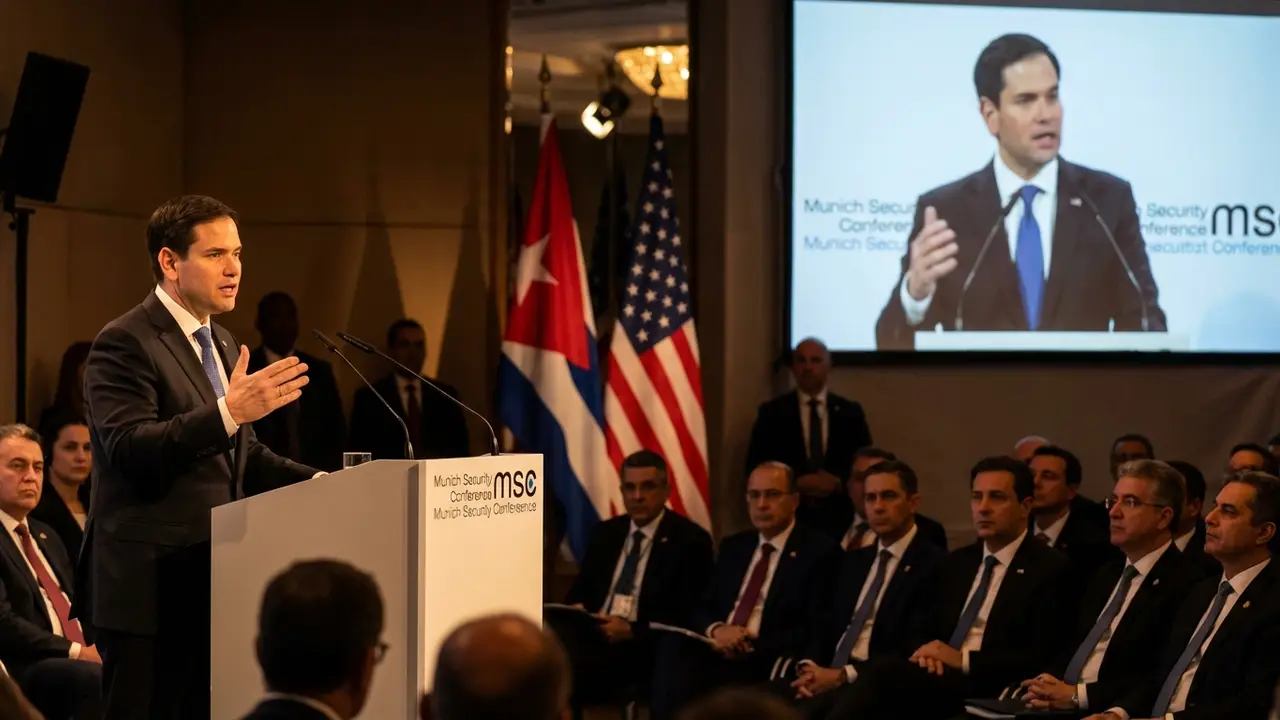
Illustration: Aroma de Cuba (AI)
U.S. Secretary of State Marco Rubio launched a sharp diplomatic offensive against Cuba’s government from the Munich Security Conference on February 14, 2026, directly linking the island’s economic collapse to the migration wave affecting the entire Western Hemisphere.
”They’d rather rule a dying country”
In remarks reported by Bloomberg and the Miami Herald, Rubio left no room for ambiguity:
“The fundamental problem that Cuba has is that it has no economy, and the people in charge of that country do not know how to improve the daily lives of their people without relinquishing power over the sectors they control.”
His most striking line summed up the diagnosis: “They would rather be in charge of a dying country than allow it to prosper.”
A crisis pushing thousands to emigrate
Rubio extended his criticism to the migration sphere, pointing to Cuba, Venezuela, and Nicaragua as the main drivers of hemispheric migration crises. “They are countries whose systems do not function,” he stated, referring to regimes that “create conditions that push thousands of citizens to leave their homes.”
The data backs this connection. According to CNBC, Cuba’s current situation is the most severe since the collapse of the Soviet Union:
- Fuel rationing and closure of tourist establishments
- Four-day work week imposed at state-owned companies
- Shortened school days due to resource shortages
- Air Canada cancelled all flights to Cuba over aviation fuel shortages
- Nicaragua ended visa-free travel for Cubans, cutting a key migration route
The Nicaragua route: closed under pressure
One of the most direct consequences for Cuban migration has been the closure of the Nicaraguan route. Since November 2021, thousands of Cubans flew to Managua visa-free before making the overland journey toward the U.S. southern border.
In February 2026, under Washington’s pressure, Nicaragua cancelled this policy, shutting down one of the most heavily used escape routes for Cubans desperate to flee the crisis.
Reforms or more pressure?
Ric Herrero, executive director of the Cuba Study Group in Washington, noted on X that the reforms Rubio demands are exactly those that “allies of the regime, supporters of engagement with Cuba, Cuba’s own economists, and everyone on the island who can’t afford basic goods have urged for years.”
Rubio highlighted one point of humanitarian contact: aid channeled through the Catholic Church, including hurricane relief assistance, though he acknowledged “that’s not a long-term solution.”
Analysts at Verisk Maplecroft cited by CNBC suggest the odds of a power transition in Cuba are increasing, drawing comparisons to Maduro’s fall in Venezuela weeks earlier.
What this means for Cubans seeking to emigrate
For the thousands of Cubans considering emigration, the picture grows more complex:
- The overland route through Nicaragua is closed
- Deportations from the U.S. continue — 170 Cubans were deported on the first flight of 2026
- ICE is intensifying arrests of Cubans with criminal records
- The CHNV program remains suspended with no signs of reactivation
Washington’s pressure aims to force the regime into reform, but in the meantime, ordinary Cubans bear the consequences of a collapsed economic system and increasingly restricted migration routes.
Cuba’s crisis enters a new phase. While diplomats debate in Munich, millions of Cubans face the hardest question: stay or leave — with fewer options for the latter every day.
Frequently asked questions
What did Rubio say about Cuba at the Munich Conference?
How does Cuba's economic crisis affect migration?
What reforms is the U.S. demanding from Cuba?
Did Nicaragua close the migration route for Cubans?
How we got here
Background
The first thing we published on this topic.
Fernández de Cossío: Cuba Open to US Dialogue, No Talks Yet
The Cuban Vice Minister of Foreign Affairs clarifies Havana's position amid Trump's claims about alleged bilateral negotiations.
Washington Demands Havana Stop Repudiation Acts Against Mike Hammer
The State Department demands Cuba cease 'repressive acts' against the American diplomat and calls the Cuban government an 'illegitimate regime.'
Related articles
Rubio Suggests Cuba Economic Opening as 'Possible Way Forward'
Secretary of State Marco Rubio said in Munich that opening Cuba's economy could be a path forward, marking a notable shift in tone on the crisis.

Cuba and Spain Foreign Ministers Meet in Madrid Amid Crisis
Bruno Rodríguez and José Manuel Albares discuss Cuba's situation in Madrid after diplomatic tour of China and Vietnam.

Cuba More Isolated Than Ever: Allies Go Silent as Exodus Risk Grows
Cuba's crisis deepens with the oil blockade, silent allies, and closed migration routes. Experts warn of a potential mass exodus like the 1994 rafters.
Nicaragua Requires Visas From 128 Countries, Shutting Cuban Route
Ortega regime imposes consulted visas on Cubans, Venezuelans and 126 other nationalities under Trump pressure.

Diplomats in Havana Prepare Evacuation as Cuba Negotiates in Secret
Embassies in Havana draw down staff as WFP warns of imminent food crisis, while Cuba and the US hold secret talks in Mexico.

Flotilla 'Nuestra América' Mobilizes Humanitarian Aid for Cuba
The Progressive International coordinates a maritime flotilla to deliver humanitarian aid to Cuba, set to depart in March.