Wifredo Lam at MoMA: Cuban Spirits Take Over New York
MoMA hosts 'When I Don't Sleep, I Dream', a retrospective of Cuban painter Wifredo Lam through April 2026. Afro-Cuban art meets surrealism.
4 min read
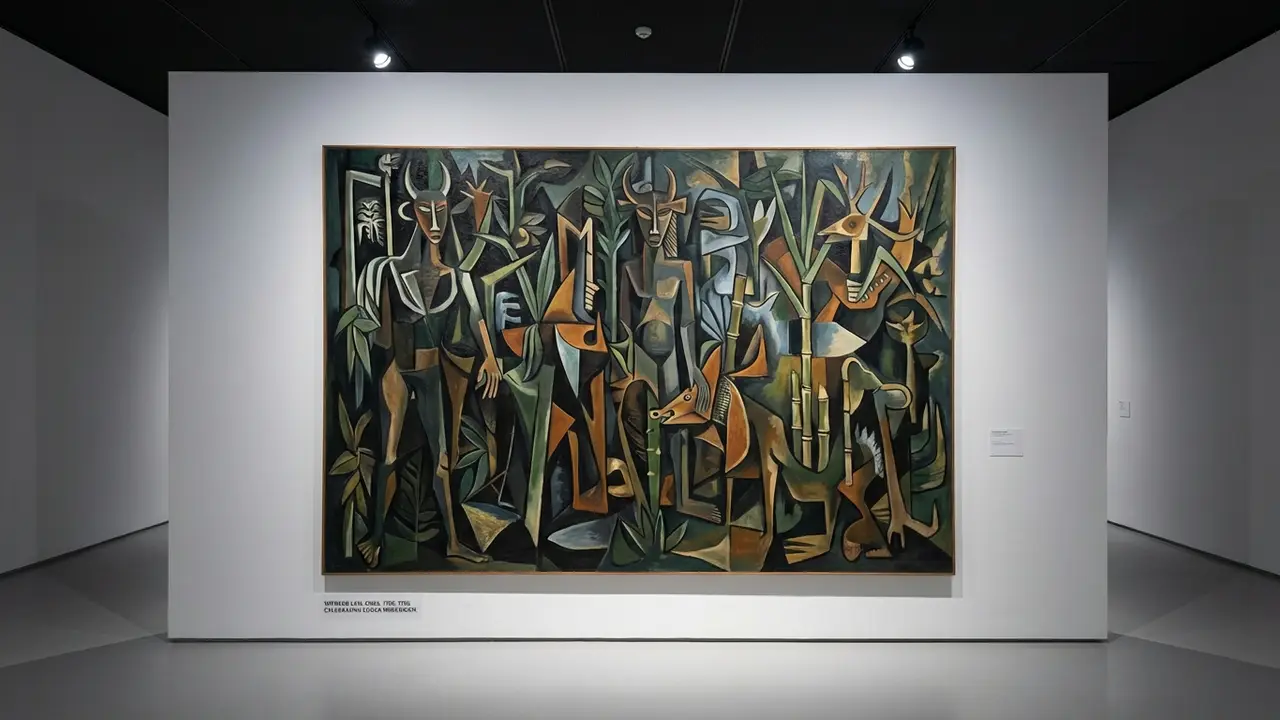
Illustration: Aroma de Cuba (AI)
The Museum of Modern Art in New York has surrendered to Cuban genius. The retrospective “When I Don’t Sleep, I Dream” brings together decades of work by Wifredo Lam (1902-1982), the artist who transformed Caribbean spirits into a pictorial revolution that shook the foundations of Western art.
A Cuban Among Giants
Born in Sagua la Grande, Cuba, Lam left the island in 1923 to study in Madrid. In the Spanish capital, he absorbed the Cubism that Pablo Picasso had unleashed upon the continent. But his political awakening as an artist came with the Civil War: in 1936, he joined the Republican army and worked in a munitions factory where chemicals sickened his body but ignited his rebellious spirit.
“The Spanish Civil War” (1937), a devastating canvas of intertwined bodies in ash gray, marks the birth of an artist willing to confront horror head-on.
Paris, Picasso, and the African Revelation
When Franco declared victory in 1938, Lam fled to Paris. There he found a community of extraordinary artists and, more importantly, found his own roots. The African masks that fascinated European modernists were, for Lam, a mirror of his heritage.
“Madame Lumumba” (1938)—titled decades later by his friend Aimé Césaire in honor of Pauline Opango, widow of the assassinated Congolese leader—displays angular faces dripping with visceral anguish.
The Jungle: An Act of Decolonization
The Nazi advance on France pushed Lam toward Martinique in 1941 and, finally, back to Cuba. Transformed by Europe but reconnected with his island, he painted his masterpiece: The Jungle (1942-43).
This canvas of nearly 8 feet square is an explosion of dark energy: toothy creatures emerge from electric green depths, shadows shimmer with blue-black sheen, a whirlwind of forms that Lam himself would call “an act of decolonization.”
“That Caribbean spirit, its magic, its legends, are all present in my paintings.” — Wifredo Lam
Lucumí, Vodou, and Caribbean Spirits
While American Abstract Expressionists fled the physical world toward “pure emotion,” Lam dug deeper into what made the world what it was. He studied the Afro-Cuban religion Lucumí, observed Vodou ceremonies in Haiti—the first independent republic torn from colonialism—and channeled furious spirits into his work.
“Song of Osmoses” (1945) is a hurricane of horned creatures and skulls in blood red and icy blue. “Omi Obini” (1943), whose title means “water woman” in reference to a Lucumí deity, is a dense thicket of fronds concealing vaguely human forms.
The MoMA Exhibition
“When I Don’t Sleep, I Dream” traces Lam’s complete trajectory: from his early Cubist portraits in Madrid to the spectral creatures of his final years in Italy. Among the highlighted works:
- The Jungle (1942-43) — the centerpiece of MoMA’s permanent collection
- The Annunciation (1944) — horned demons and winged angels in gray fog
- Canaima III (1947) — dark portrait with horns invoking South American shamanism
- Grand Composition (1949) — his Cuban response to Picasso’s Guernica
The exhibition remains open through April 11, 2026.
An Artist Ahead of His Time
Wifredo Lam died in Paris in 1982, but his legacy continues to grow. As Boston Globe critic Murray Whyte notes, Lam was “an artist more at home in our era than his own.” His fusion of European modernism and Afro-Caribbean spirituality anticipated decades of discussions about identity, colonialism, and art’s power to challenge dominant narratives.
For those of us who love Cuban culture, Wifredo Lam is a reminder that the island’s roots—African, Spanish, Caribbean—can flourish in any museum in the world.
The exhibition “When I Don’t Sleep, I Dream” is open at MoMA in New York through April 11, 2026. Address: 11 West 53 Street, New York, NY.
Frequently asked questions
When can you see the Wifredo Lam exhibition at MoMA?
Why is Wifredo Lam important to Cuban art?
What is Wifredo Lam's most famous painting?
What influences shaped Wifredo Lam's art?
How we got here
Background
The first thing we published on this topic.
Cuban Music Conquers the Latin Grammys
Cuban artists sweep the ceremony with awards in multiple tropical music categories.
Old Havana Restoration Reaches a New Milestone
Rehabilitation work in the historic quarter reveals colonial frescoes from the 18th century.
Related articles
Modern Cuban Painters: NY Revives Historic 1944 MoMA Exhibition
Bonhams reunites works from MoMA's legendary show for the first time in 80 years, featuring Wifredo Lam, Amelia Peláez, and the Cuban avant-garde.
Wifredo Lam: The Cuban Painter Who Fused Africa and Surrealism
Discover Wifredo Lam, the Cuban artist who revolutionized art by merging surrealism, cubism, and Afro-Cuban spirituality.
Cimafunk Conquers Jam Cruise 2026: Afro-Cuban Funk Takes Over
Cuban artist Cimafunk triumphs at Jam Cruise 22 with his fusion of funk and Afro-Cuban rhythms. Meet the Cuban James Brown.
Nueva Trova Cubana: The Revolution Made Song That Shaped History
History of the Cuban musical movement that united poetry, guitar and social commitment. Silvio Rodríguez, Pablo Milanés and their legacy.
The Cuban Guayabera: History of the Shirt That Defines Cuba
From the Yayabo River to presidential summits: the guayabera was born peasant and became a symbol of Cuban elegance. Discover its history.
Screen Cuba 2026: Cuban Cinema Conquers London This March
Screen Cuba festival brings ICAIC classics to London March 15-28. Lucía, The Twelve Chairs, and more Cuban masterpieces on screen.