Nueva Trova Cubana: The Revolution Made Song That Shaped History
History of the Cuban musical movement that united poetry, guitar and social commitment. Silvio Rodríguez, Pablo Milanés and their legacy.
4 min read
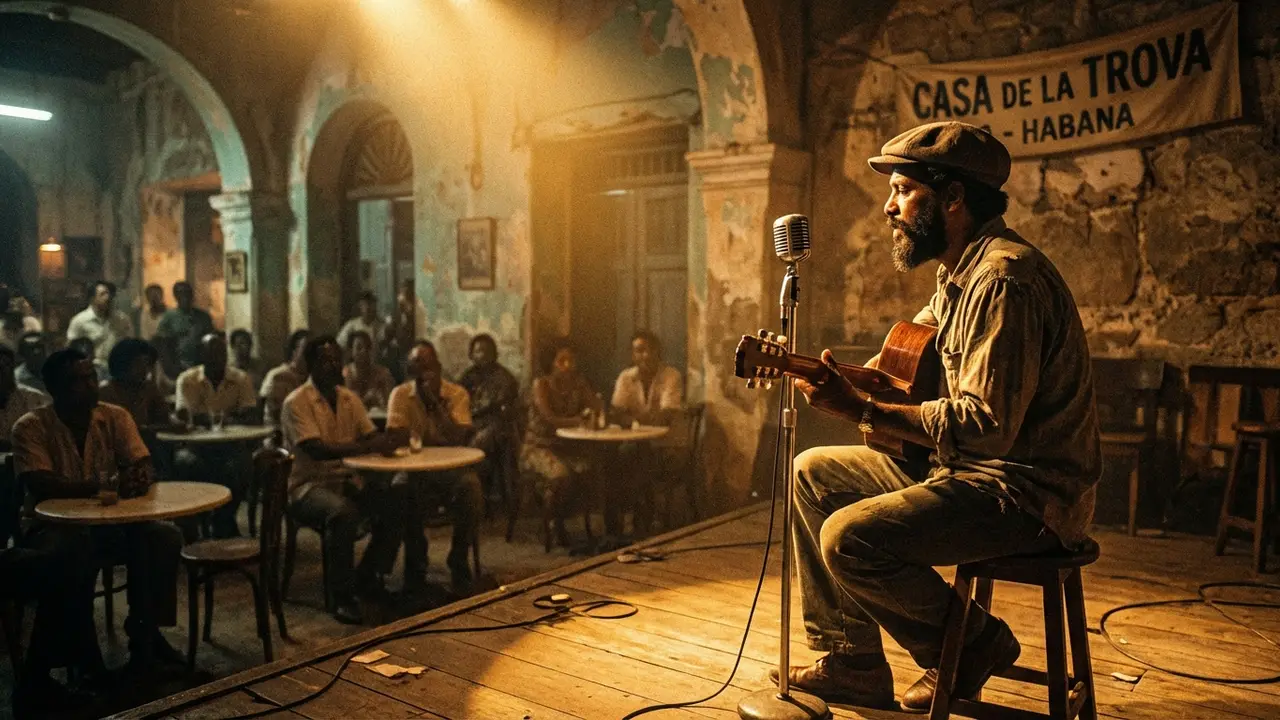
Illustration: Aroma de Cuba (AI)
In September 2025, amid one of the worst crises Cuba has experienced, Silvio Rodríguez climbed the steps of Havana’s university to offer a free concert. Three generations united that night, singing the same songs their parents and grandparents had sung decades before. This is the intact power of Nueva Trova Cubana: a movement that turned the guitar into a poetic weapon and song into a collective refuge.
The Birth of a Movement
Nueva Trova didn’t emerge from nowhere. It drew from the wellspring of traditional Cuban trova —that tradition of wandering singers with guitars who traversed the island since the 19th century— but transformed it with the urgencies of its time.
In 1967, Casa de las Américas organized the First Protest Song Encounter. There, the young artists who would define the movement first came together:
- Silvio Rodríguez (San Antonio de los Baños, 1946)
- Pablo Milanés (Bayamo, 1943-2022)
- Noel Nicola (Havana, 1946-2005)
They would later be joined by Vicente Feliú, Sara González, and other trovadores who expanded the movement’s sound.
The Official Founding: 1972
The Nueva Trova Movement was formally established in 1972. That same year, Silvio, Pablo, and Noel traveled to Chile to participate in a festival in Valparaíso, establishing fraternal bonds with the Nueva Canción Chilena of Víctor Jara, Inti-Illimani, and Quilapayún.
The 1973 coup in Chile transformed that brotherhood into mourning. Songs like Silvio Rodríguez’s “Santiago de Chile” were born from that shared grief.
What Makes Nueva Trova Unique?
Sung Poetry
Nueva Trova lyrics aren’t simple songs: they’re musicalized poetry collections. Silvio Rodríguez, influenced by César Vallejo and Pablo Neruda, brought symbolism and metaphor to unexplored territories in popular music.
“The songbooks of this great trovador are poetry collections”
— Daniel Mordzinski, photographer
Commitment Without Pamphlets
Unlike more direct protest song, Nueva Trova approached social themes from existential intimacy. Songs like “Ojalá” speak of heartbreak, but also of impossibility and utopia. “El Necio” (The Stubborn One) is autobiography and manifesto simultaneously.
Musical Sophistication
Pablo Milanés brought his training from the Municipal Conservatory of Havana, fusing trova with elements of jazz, Cuban filin, and Brazilian music. The result was a harmonically richer sound than their predecessors.
The Songs That Defined an Era
”Ojalá” (1969) - Silvio Rodríguez
Paradoxically one of the most sung love songs in Spanish, it’s actually a wish for forgetfulness. Its repetitive structure and hypnotic melody made it a generational anthem.
”Yolanda” (1970) - Pablo Milanés
Dedicated to his wife, it’s perhaps the most perfect love song written in Cuba. Its harmonic simplicity hides an emotional depth that has transcended decades.
”Unicornio” (1982) - Silvio Rodríguez
Originally written for children, it became a symbol of lost innocence and dreams. Each generation reinterprets it according to their own losses.
The Living Legacy
A New Book: “Silvio Rodríguez: diary of a trovador”
In February 2026, Argentine photographer Daniel Mordzinski —known as “the photographers of writers”— presented at the Hay Festival in Cartagena a book with 143 unpublished photographs of Silvio Rodríguez. The work captures the trovador in his most human dimension: his home, his family, his dogs, his tours across Latin America.
Mordzinski discovered Silvio’s music in Paris in 1980, exiled from the Argentine dictatorship. “In those times of scarcity and dreams, Silvio’s songs were balm,” he wrote.
Silvio at 79
Despite Cuba’s crisis, Silvio Rodríguez continues offering free concerts in Havana’s neighborhoods —his famous “Concerts in the Barrios” that he’s been performing since 2010. In January 2026, he participated in a trovador festival in central Cuba, accompanied by his daughter Malva and his wife Niurka González.
Pablo Milanés: The Eternal Legacy
Following Pablo Milanés’s passing in Madrid in November 2022, his music has experienced a renaissance among new generations. His songs continue to play at weddings, funerals, and demonstrations throughout Latin America.
Nueva Trova and Cuban Identity
For the Cuban diaspora, Nueva Trova songs are anchors of identity. Political position doesn’t matter: “Yolanda,” “Ojalá,” or “Pequeña serenata diurna” belong to all Cubans, inside and outside the island.
As Silvio wrote after his concert on the Havana steps: “Various generations united by necessity seemed to find themselves.” That’s the magic of trova: creating community through song.
To Explore Further
- Essential Silvio discography: Días y flores (1975), Al final de este viaje (1978), Unicornio (1982)
- Essential Pablo discography: Pablo Milanés (1976), Años (1984), Comienzo y final de una verde mañana (2000)
- Documentary: Silvio Rodríguez: ojalá (2023)
Nueva Trova proved that song can be poetry, guitar can be revolution, and that some melodies are capable of uniting three generations under the same Havana moon.
Frequently asked questions
What is Nueva Trova Cubana?
When was the Nueva Trova Movement officially founded?
What are the most famous Nueva Trova songs?
Why did Nueva Trova have such influence across Latin America?
How we got here
Background
The first thing we published on this topic.
Cuban Music Conquers the Latin Grammys
Cuban artists sweep the ceremony with awards in multiple tropical music categories.
Son Cubano: The Rhythm That Conquered the World
From the mountains of Oriente to Broadway stages. History, instruments, and legends of the musical genre that defines Cuba.
Related articles
Nueva Trova: Silvio Rodríguez, Pablo Milanés and Cuba's Revolution
The history of Cuba's Nueva Trova movement, where Silvio Rodríguez and Pablo Milanés fused poetry, guitar, and revolution into songs that shaped Latin America.
Modern Cuban Painters: NY Revives Historic 1944 MoMA Exhibition
Bonhams reunites works from MoMA's legendary show for the first time in 80 years, featuring Wifredo Lam, Amelia Peláez, and the Cuban avant-garde.
Wifredo Lam at MoMA: Cuban Spirits Take Over New York
MoMA hosts 'When I Don't Sleep, I Dream', a retrospective of Cuban painter Wifredo Lam through April 2026. Afro-Cuban art meets surrealism.
Cimafunk Conquers Jam Cruise 2026: Afro-Cuban Funk Takes Over
Cuban artist Cimafunk triumphs at Jam Cruise 22 with his fusion of funk and Afro-Cuban rhythms. Meet the Cuban James Brown.

The Cuban Guayabera: History of the Shirt That Defines Cuba
From the Yayabo River to presidential summits: the guayabera was born peasant and became a symbol of Cuban elegance. Discover its history.
The Cuban Tres: The Instrument That Forged the Soul of Son
From Baracoa to world stages: the history of the Cuban tres and Pancho Amat, the master bringing its sound across Europe in 2026.