Wifredo Lam: The Cuban Painter Who Fused Africa and Surrealism
Discover Wifredo Lam, the Cuban artist who revolutionized art by merging surrealism, cubism, and Afro-Cuban spirituality.
6 min read
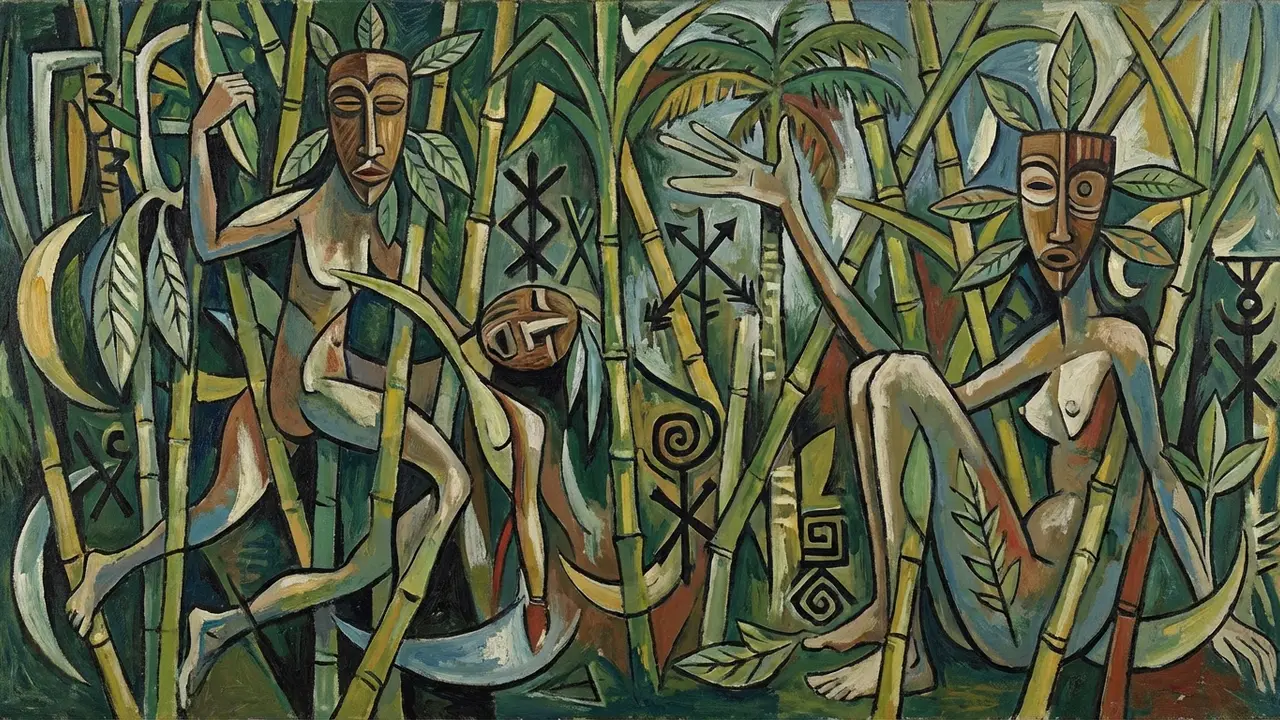
In the pantheon of Latin American art, few names shine as brightly as Wifredo Lam. Born in Sagua la Grande, a sugar-producing town in Villa Clara province, this artist of Chinese, African, and Spanish blood achieved something no other Cuban painter has: he placed Afro-Cuban spirituality at the center of the global art world.
His work is neither decorative nor folkloric. It’s a visual cry connecting Cuba’s sugarcane fields to the galleries of Paris and New York, the orishas of Santería to André Breton’s surrealism, and African heritage to 20th-century European avant-gardes.
From Sagua la Grande to the world
Wifredo Óscar de la Concepción Lam y Castilla was born on December 8, 1902. His father, Yam Lam, was a Chinese immigrant from Canton; his mother, Ana Serafina Castilla, was the daughter of a former Congolese slave and a Cuban mulatto. This mix of bloodlines — Chinese, African, Spanish — would define his entire body of work.
In Sagua la Grande, young Wifredo grew up immersed in two spiritual worlds: official Catholicism and the Afro-Cuban practices his godmother, Matonica Wilson, a Santería priestess celebrated locally as a healer, taught him to respect. The orishas, Palo Monte rituals, and Abakuá ceremonies left an indelible mark on his imagination.
“I wanted with all my heart to paint the drama of my country… To respond to the reality of the new world, I had to turn to the spirit of the jungle.” — Wifredo Lam
Spain: war, love, and tragedy
In 1923, Lam traveled to Madrid to study art under Fernando Álvarez de Sotomayor, director of the Museo del Prado and teacher of Salvador Dalí. Mornings he painted in the academic studio; evenings he explored the avant-garde with young rebel painters.
At the Prado, he discovered Hieronymus Bosch and Pieter Brueghel, whose grotesque and fantastical figures resonated with the visions of his Cuban childhood. But Spain also brought tragedy: in 1929 he married Eva Piriz, who died of tuberculosis along with their young son in 1931. This loss deeply marked the dark tone of his art.
When the Spanish Civil War broke out, Lam joined the Republican side, designing propaganda posters and fighting in the defense of Madrid. Wounded in combat, he was evacuated to Barcelona, where he met Catalan sculptor Manolo Hugué, who gave him the letter of introduction that would change his life.
Paris: Picasso, Breton, and the avant-garde
In 1938, Lam arrived in Paris with that letter in his pocket. Pablo Picasso welcomed him into his studio and was impressed. The Spaniard recognized in the Cuban a kindred spirit — someone who understood African masks not as “primitive art” but as expressions of a living worldview.
Picasso became his mentor and gateway to the Parisian art world:
- Henri Matisse showed him the power of pure color
- André Breton embraced him into the Surrealist movement
- Georges Braque reinforced his interest in Cubist fragmentation
- Fernand Léger taught him the monumentality of forms
But Lam was never an imitator. He absorbed these influences and filtered them through his unique experience as a mixed-race Caribbean man. While European Surrealists sought the “unconscious” in dreams, Lam found it in the Afro-Cuban rituals he had lived as a child.
The Jungle: the masterpiece
In 1941, fleeing the Nazi occupation, Lam returned to Cuba. The reunion with his homeland was a creative earthquake. After nearly two decades in Europe, he saw with fresh eyes the exploitation of sugar workers, the racism against Afro-Cubans, and the spiritual vitality that the white elite dismissed as “witchcraft.”
From this collision emerged The Jungle (1943), his absolute masterpiece. This monumental gouache on paper (7.9 × 7.5 feet) depicts:
- Hybrid figures — half human, half plant, with mask-like faces
- Sugarcane stalks merging with human limbs — a metaphor for slavery
- A tropical density that simultaneously suffocates and liberates
- Giant scissors evoking the sugar harvest and colonial mutilation
The Jungle is not a pretty landscape. It’s a denunciation of colonial exploitation disguised as tropical paradise. And simultaneously, it’s a celebration of Afro-Cuban spiritual power that survived centuries of oppression.
Today it hangs at the Museum of Modern Art (MoMA) in New York, where it remains one of the most visited works in the permanent collection.
The Lam style: hybrid figures and visual syncretism
What makes Wifredo Lam unique is his ability to create an entirely new visual language. His hybrid figures — part human, part animal, part plant — are not decorative whims. They represent the syncretism that defines Cuba:
- Mask-faces: simultaneously evoking African Yoruba art masks, Picasso’s Cubist figures, and the íreme dancers of the Abakuá
- Calligraphic lines: inherited from his father’s Chinese culture, recalling ink painting and Chinese brushwork
- Invasive vegetation: Cuba’s tropical nature as an untameable living force
- Horns and leaves: symbols of the orishas merging with the landscape
Lam spoke of being “a mulatto of many worlds” — African, Spanish, Chinese. His art is mestizaje made painting.
Legacy and influence
After The Jungle, Lam divided his time between Cuba, Paris, and Italy until his death in 1982. His influence is immense:
- Guggenheim International Award in 1964
- Works in the MoMA, the Tate, the Guggenheim, and the Centre Pompidou
- The Wifredo Lam Center for Contemporary Art in Old Havana, opened in 1983, organizes the celebrated Havana Biennial
- Direct inspiration for artists like Jean-Michel Basquiat and an entire generation of Caribbean and African diaspora artists
In 2025, MoMA organized the retrospective “Wifredo Lam: When I Don’t Sleep, I Dream”, confirming his place among the giants of 20th-century art.
Wifredo Lam and Cuban identity
Lam’s importance extends beyond art. In an era when Cuban elites despised Afro-Cuban culture, he elevated it to universal status. He proved that the orishas, the sugarcane fields, and Cuba’s syncretic traditions were not “primitive folklore” but sources of an artistic vision as powerful as any European movement.
Today, when you walk through Old Havana and see the Wifredo Lam Center, or when you visit MoMA and stand before The Jungle, you’re seeing the fruit of a life dedicated to proving that Cuba is not on the periphery of art — it’s at its center.
Want to explore more Cuban culture? Read about Santería and the orishas, the Abakuá secret society, or Cuban poster art.
Frequently asked questions
Who was Wifredo Lam?
What is Wifredo Lam's most famous painting?
What was Wifredo Lam's relationship with Picasso?
Where can I see Wifredo Lam's art in Cuba?
How we got here
Background
The first thing we published on this topic.
Cuban Music Conquers the Latin Grammys
Cuban artists sweep the ceremony with awards in multiple tropical music categories.
Old Havana Restoration Reaches a New Milestone
Rehabilitation work in the historic quarter reveals colonial frescoes from the 18th century.
Related articles
Wifredo Lam at MoMA: Cuban Spirits Take Over New York
MoMA hosts 'When I Don't Sleep, I Dream', a retrospective of Cuban painter Wifredo Lam through April 2026. Afro-Cuban art meets surrealism.
Modern Cuban Painters: NY Revives Historic 1944 MoMA Exhibition
Bonhams reunites works from MoMA's legendary show for the first time in 80 years, featuring Wifredo Lam, Amelia Peláez, and the Cuban avant-garde.
Cuban Photography: From Korda to Today, the Eye That Captured Cuba
The history of Cuban photography: Alberto Korda, Raúl Corrales, the iconic Che image, and new photographers documenting Cuba today.
Tropicana: The Paradise Under the Stars That Dazzled the World
The history of Havana's Tropicana cabaret from 1939 to today. Architecture, shows, and its enduring Cuban cultural legacy.
Cuban Poster Art: The Graphic Design Movement That Changed the World
The history of Cuban cartelismo, from ICAIC film posters to OSPAAAL solidarity art. How Cuba created a revolutionary graphic design language.
Cuban Hip-Hop: From Alamar to the World, Cuba's Rap Revolution
The history of Cuban hip-hop from Alamar to today. How rap became the voice of a generation during Cuba's Special Period crisis.