Cuban Santería: The Religion of the Orishas and Its Power
Discover Cuban Santería, its orishas, rituals, the 2026 Letra del Año prophecy, and how this Afro-Cuban religion thrives today.
5 min read
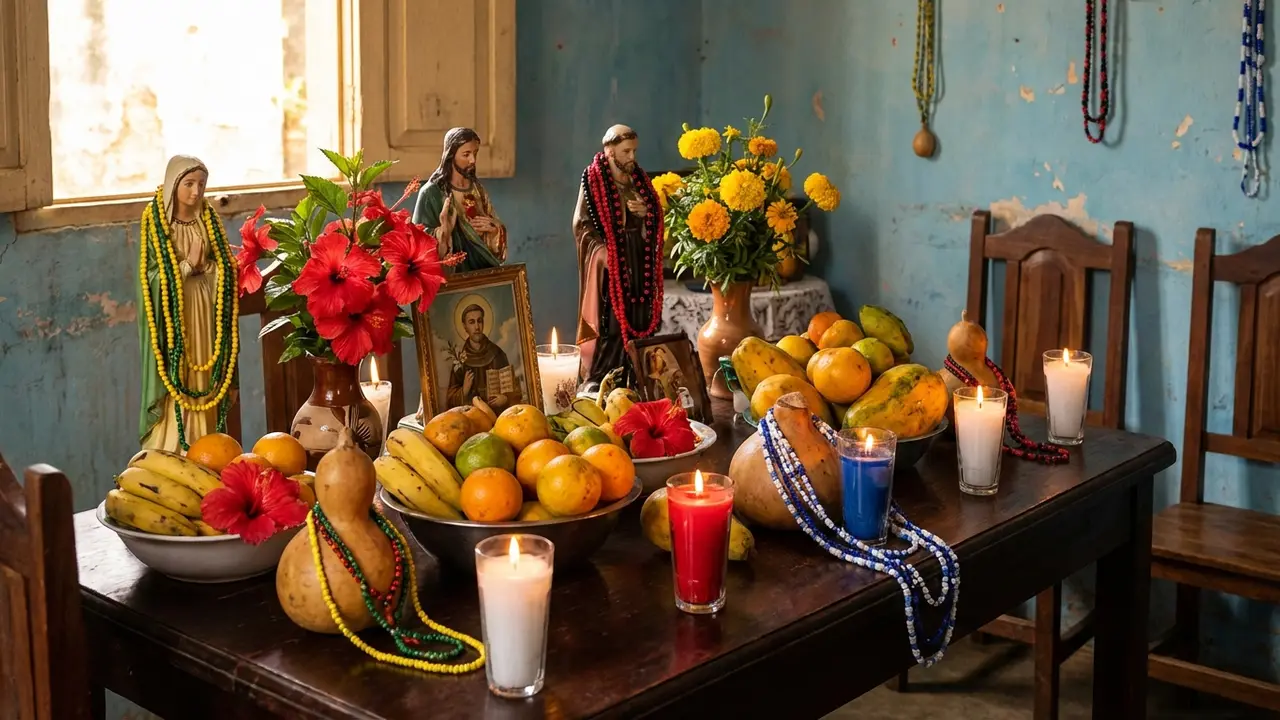
Illustration: Aroma de Cuba (AI)
From Africa to Cuba: the birth of a faith
Santería — formally known as Regla de Ocha-Ifá or Lucumí — is far more than a religion. It is Cuba’s spiritual heartbeat, a living tradition that connects millions of Cubans to their African roots despite centuries of oppression.
It all began with the transatlantic slave trade. Between the 16th and 19th centuries, hundreds of thousands of Yoruba people — from what is now Nigeria and Benin — were torn from their homeland and brought to Cuba to labor on sugar plantations. They carried something no chains could take: their faith.
Spanish colonizers banned African religious practices and forced enslaved people to be baptized as Catholics. But the Yoruba found an ingenious solution: they hid their orishas behind Catholic saints. Changó became Saint Barbara, Yemayá took on the face of the Virgin of Regla, and Oshún became Our Lady of Charity of El Cobre, Cuba’s patron saint.
This syncretism was not submission — it was resistance. A brilliant way to preserve a millennia-old worldview behind the mask of the imposed faith.
The orishas: gods who walk among us
Unlike religions with a distant god, in Santería the orishas are living forces that intervene directly in daily life. Each person is born under the protection of a particular orisha, revealed through divination.
The principal orishas
| Orisha | Domain | Catholic syncretism | Colors |
|---|---|---|---|
| Obatalá | Creation, peace, purity | Our Lady of Mercy | White |
| Changó | Thunder, fire, virility | Saint Barbara | Red and white |
| Yemayá | Seas, motherhood | Virgin of Regla | Blue and white |
| Oshún | Love, rivers, fertility | Our Lady of Charity | Yellow and gold |
| Elegguá | Paths, destiny, beginnings | Saint Anthony / Holy Child of Atocha | Red and black |
| Oggún | Iron, war, labor | Saint Peter | Green and black |
| Orula | Wisdom, divination | Saint Francis of Assisi | Green and yellow |
| Oyá | Wind, cemeteries, change | Our Lady of Candelaria | Brown and multicolor |
| Babalú Ayé | Disease, healing | Saint Lazarus | Purple and burlap |
Saint Lazarus (Babalú Ayé) is perhaps Cuba’s most venerated orisha. Every December 17th, thousands of Cubans make pilgrimage to the Sanctuary of El Rincón in Havana, crawling on their knees and fulfilling promises in one of the Caribbean’s most powerful religious processions.
Aché: the energy that moves the universe
In Yoruba cosmology, everything possesses aché (ashé): the vital force, the spiritual power that flows through nature, people, and the orishas. Santería rituals seek to maintain, restore, or increase one’s aché.
Fundamental elements of worship include:
- Bead necklaces (elekes): Colored beads representing one’s protective orishas
- Batá drums: Sacred instruments that “speak” to the orishas through specific rhythms
- Offerings (ebbó): Fruits, animals, honey, rum, or tobacco depending on each orisha
- Divination: Through the Ifá system, cowrie shells (diloggún), or coconut (obi)
- Ritual possession: During ceremonies, orishas may “mount” devotees
The religious hierarchy
Santería has a complex structure of knowledge and authority:
- Aleyo: The uninitiated, the seeker
- Iyawó: The newly initiated (must dress in white for one year)
- Santero/Santera (Olorisha): Priest/priestess consecrated to an orisha
- Babalawo: Priest of Ifá, highest authority in divination (exclusively male)
- Italero: Specialist in interpreting the Ifá oracle
Initiation, or “making saint” (Kariocha), is a seven-day process involving secret rituals, sacrifices, and the revelation of one’s tutelary orisha. It is a spiritual rebirth that transforms the initiate’s life forever.
Letra del Año 2026: Oggún rules
Every January 1st, Cuba’s babalawos gather to consult the Ifá oracle and reveal the Letra del Año (Letter of the Year): spiritual predictions and guidance for the coming twelve months. It is an event that transcends religion — millions of Cubans, believers or not, anxiously await these prophecies.
In 2026, as reported by Associated Press, both the Letra del Año Commission of 10 de Octubre and the Yoruba Cultural Association of Cuba agreed: the ruling deity is Oggún, lord of metals, weapons, and conflict.
Key warnings include:
- Danger of armed conflicts and wars
- Increase in violence and criminal acts
- Infectious, stomach, and liver diseases
- Proliferation of fires and accidents
- “Significant changes within the government”
“The danger of war is there,” declared babalawo Víctor Betancourt. “Cuba should use diplomacy. We would be the biggest losers.”
Beyond Cuba: a global faith
Santería has crossed borders. The Cuban diaspora carried it first to Miami and New York, then it spread to Mexico, Venezuela, Colombia, Brazil, and Spain. In 1993, the U.S. Supreme Court ruled in favor of the Church of Lukumi Babalu Aye in Hialeah, Florida, protecting Santería rituals under religious freedom.
Today, the Museum of the Orishas in Old Havana welcomes visitors from around the world, and Cuban cultural figures — from musicians to athletes — openly acknowledge their faith in the orishas.
Santería is neither folklore nor superstition. It is a living tradition, a philosophy of life that has survived slavery, colonization, religious persecution, and revolution. In every home altar, in every beat of the batá drum, in every string of beads, pulses the aché of a people who never stopped believing.
Interested in Cuban culture? Also read about the Santiago de Cuba Carnival and the history of Cuban rumba.
Frequently asked questions
What is Cuban Santería?
Who are the main orishas in Santería?
What is the Letra del Año and why does 2026 matter?
Is Cuban Santería practiced outside Cuba?
How we got here
Background
The first thing we published on this topic.
Cuban Music Conquers the Latin Grammys
Cuban artists sweep the ceremony with awards in multiple tropical music categories.
Son Cubano: The Rhythm That Conquered the World
From the mountains of Oriente to Broadway stages. History, instruments, and legends of the musical genre that defines Cuba.
Related articles
Cuban Santería: The Orishas and Syncretism That Define Cuba
Discover Cuban Santería, the Afro-Cuban religion blending Yoruba traditions with Catholicism. Orishas, rituals, and cultural influence.
José Martí: Cuba's Apostle Who Built a Nation Through Poetry
Life and legacy of José Martí, Cuban national hero, modernist poet, and independence leader. From prison to the Versos sencillos.
Bad Bunny at Super Bowl LX: Cuba Present on the World's Biggest Stage
Bad Bunny included the Cuban flag in Super Bowl LX, moving Cubans amid crisis. Analysis of the most Latino halftime show in history.
La Cosa: The Secret Language That Reveals Cuba's Soul
When a Cuban asks '¿Cómo está la cosa?', they say everything while saying nothing. Discover the coded language that defines Cuban resilience.

Félix González-Torres: Sweet Revenge Arrives in Madrid May 2026
The Reina Sofía Museum presents a major retrospective of the Cuban artist who turned candy and lightbulbs into visual poetry.
Carlos Acosta Reinvents The Nutcracker with Cuban Flavor
The legendary Cuban dancer transforms the holiday classic with Nutcracker in Havana, fusing classical ballet with Afro-Cuban rhythms.