Cuban Hip-Hop: From Alamar to the World, Cuba's Rap Revolution
The history of Cuban hip-hop from Alamar to today. How rap became the voice of a generation during Cuba's Special Period crisis.
5 min read
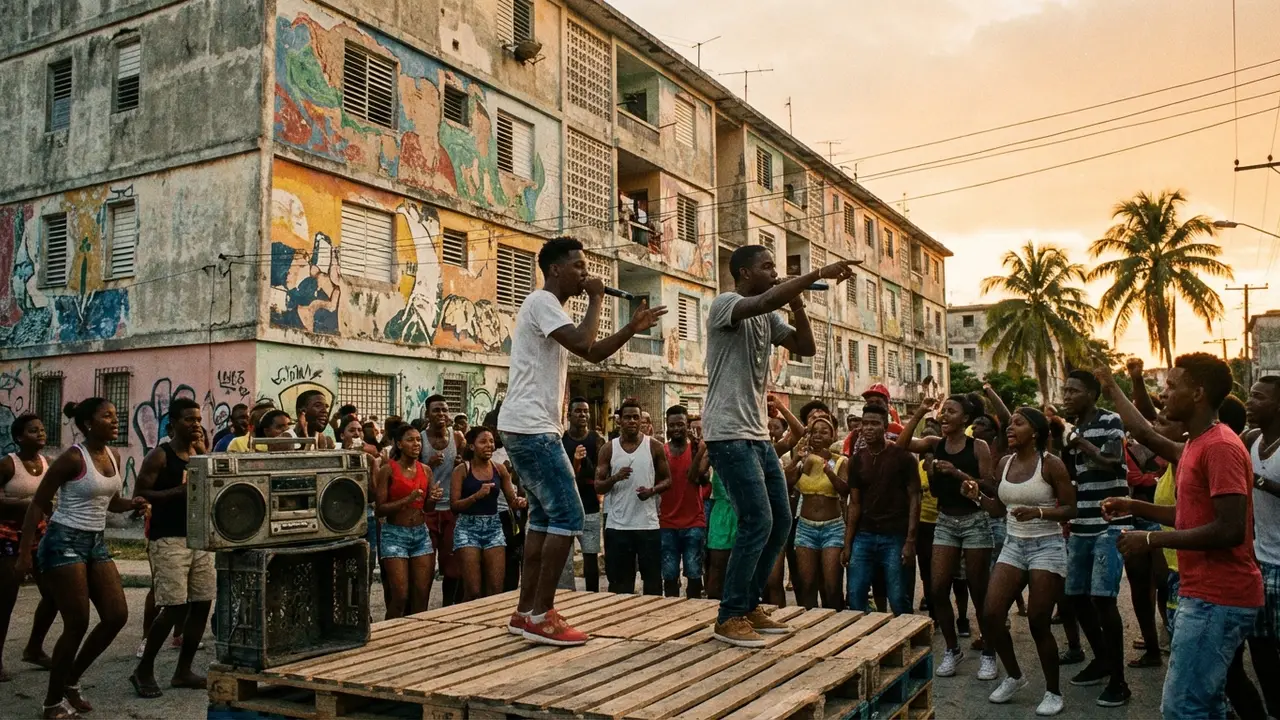
Illustration: Aroma de Cuba (AI)
From homemade antennas in Alamar to a rap revolution
In the gray concrete towers of Alamar, a Soviet-style housing project on Havana’s eastern edge, something unplanned happened. In the mid-1980s, Cuban teenagers started building homemade antennas on their balconies to catch signals from Miami radio stations like WEDR 99 Jams and Hot 105. What came through the airwaves wasn’t just music — it was an entire culture.
Breakdancing came first. Then graffiti. And finally, when the Special Period hit Cuba with full force in the 1990s, Alamar’s youth found in rap the perfect tool to say what couldn’t be said anywhere else.
The Special Period: the crisis that birthed a movement
When the Soviet Union collapsed in 1991, Cuba lost 80% of its imports overnight. Blackouts lasted up to 16 hours. Food became scarce. Transportation collapsed. And in the middle of that chaos, a generation of young people — predominantly Black and mixed-race — faced a reality that official slogans couldn’t disguise.
Tourism brought dollars but also visible racial inequality. Black Cubans had less access to remittances from relatives abroad and faced discrimination in the tourism sector. Rap became the space to name those contradictions.
“We are the generation that grew up on promises and woke up abandoned.” — Hermanos de Causa
The Alamar Rap Festival: 1995, year zero
In August 1995, the first Alamar Rap Festival was held, organized by the rappers themselves in the neighborhood amphitheater. No institutional support, no budget, no media coverage. Just microphones, drum machines, and the urgency to be heard.
What began as a local event grew rapidly. By the late 1990s, the festival attracted thousands of attendees and international artists. Black Star (Mos Def and Talib Kweli) traveled to Alamar. Dead Prez performed there. Cuban hip-hop was no longer a neighborhood phenomenon — it had become a cultural movement.
The pioneers: voices that broke the silence
Obsesión
The duo of Alexey Rodríguez (El Tipo Este) and Magia López is perhaps the most respected act in Cuban rap. Obsesión tackles racism, feminism, and social inequality with a lyrical depth that makes them the movement’s chroniclers. Magia López is also one of the most powerful feminist voices in hip-hop culture across all of Latin America.
Hermanos de Causa
Soandry del Río and Pelón were the first to bring Cuban rap into a poetic language that resonated with Cuba’s literary tradition. Their track “Tengo” — a direct reference to the poem by Nicolás Guillén — became a generational anthem.
Orishas: the international breakthrough
When Yotuel, Roldán, and Flaco Pro formed Orishas in Paris in 1999, Cuban hip-hop crossed the Atlantic. Their debut album A lo Cubano (2000) fused rap with son cubano, rumba, and santería chants, selling over one million copies in Europe. The song “Represent” put Cuba on the global hip-hop map.
Los Aldeanos
Aldo Roberto Rodríguez (Aldo) and Bian Oscar Rodríguez (El B) pushed underground Cuban rap to its peak. With blunt, uncensored lyrics, Los Aldeanos distributed their music on USB drives and burned CDs, achieving massive popularity without any institutional or label support.
Fidel, the Cuban Rap Agency, and the paradox of control
In 2002, something unexpected happened: Fidel Castro declared hip-hop the “vanguard of the Revolution.” The government created the Cuban Rap Agency, a state body that published the magazine Movimiento and organized official events.
For some artists, it was an opportunity for legitimacy. For many others, it was a trap. The Agency controlled who recorded, who performed, and what could be said. Rodolfo Rensoli, a key figure in organizing the Alamar Festival, later denounced how the Asociación Hermanos Saíz and the Ministry of Culture intervened to co-opt a movement that had been born free.
The result was a fracture: “official” hip-hop and underground hip-hop. The most critical artists — Los Aldeanos, Escuadrón Patriota, El Libre — kept producing outside the system, distributing music hand-to-hand through what became known as the “paquete semanal” (weekly package).
What makes Cuban rap unique
Unlike American hip-hop, Cuban rap draws from roots that go far deeper than digital sampling:
- Rumba and batá drums: Afro-Cuban percussion and Yoruba chants are organically woven into the beats
- Décima and poetry: The tradition of punto cubano and improvisational repentismo echoes in Cuban freestyle
- Social consciousness: Cuban rap prioritizes message over materialism. Lyrics address racism, migration, identity, and survival
- Natural fusion: Groups like Orishas, Cimafunk, and Telmary blend hip-hop with funk, jazz, electronic, and son without it feeling forced
The legacy: a generation that changed Cuba
Cuban hip-hop didn’t conquer Billboard charts or fill international stadiums (with exceptions like Orishas). But it did something more important: it gave voice to a generation the official narrative ignored. It spoke about racism when saying “racism in Cuba” was taboo. It spoke about inequality when the narrative was equality. It spoke about emigration when leaving was considered betrayal.
Today, artists like Telmary Díaz, Danay Suárez, and Cimafunk himself carry that legacy into new sonic territories. The Alamar festival no longer exists in its original form, but its spirit lives in every Cuban rapper who grabs a microphone and speaks their truth.
From the balconies of Alamar to the stages of Europe, Cuban hip-hop proves that the most powerful culture doesn’t come from recording studios — it comes from necessity.
Interested in Cuban music? Discover the history of son cubano, timba, and the legacy of Arsenio Rodríguez.
Frequently asked questions
Where was Cuban hip-hop born?
What are the most important Cuban rap groups?
Did Fidel Castro support Cuban hip-hop?
How is Cuban rap different from American hip-hop?
How we got here
Background
The first thing we published on this topic.
Cuban Music Conquers the Latin Grammys
Cuban artists sweep the ceremony with awards in multiple tropical music categories.
Son Cubano: The Rhythm That Conquered the World
From the mountains of Oriente to Broadway stages. History, instruments, and legends of the musical genre that defines Cuba.
Related articles
Bad Bunny at Super Bowl LX: Cuba Present on the World's Biggest Stage
Bad Bunny included the Cuban flag in Super Bowl LX, moving Cubans amid crisis. Analysis of the most Latino halftime show in history.

Tropicana: The Paradise Under the Stars That Dazzled the World
The history of Havana's Tropicana cabaret from 1939 to today. Architecture, shows, and its enduring Cuban cultural legacy.
Cuban Musical Instruments: Bongos, Congas, Tres and Claves Guide
Complete guide to Cuban musical instruments: bongos, congas, tres cubano, claves, maracas and timbales. History, sounds and where to buy.
Danzón: Cuba's National Dance Born in Matanzas in 1879
The history of Cuban danzón, from Miguel Failde's Las Alturas de Simpson to its influence on mambo and cha-cha-chá.
Cuban Books: 12 Essential Works of Cuban Literature You Must Read
Discover the must-read Cuban books from José Martí to Leonardo Padura. A guide to essential Cuban literature and where to buy them.
Cuban Photography: From Korda to Today, the Eye That Captured Cuba
The history of Cuban photography: Alberto Korda, Raúl Corrales, the iconic Che image, and new photographers documenting Cuba today.