Arsenio Rodríguez: The Blind Marvel Who Revolutionized Cuban Music
Meet Arsenio Rodríguez, the blind tres genius who created the conjunto format, son montuno, and laid the foundations of modern salsa.
5 min read
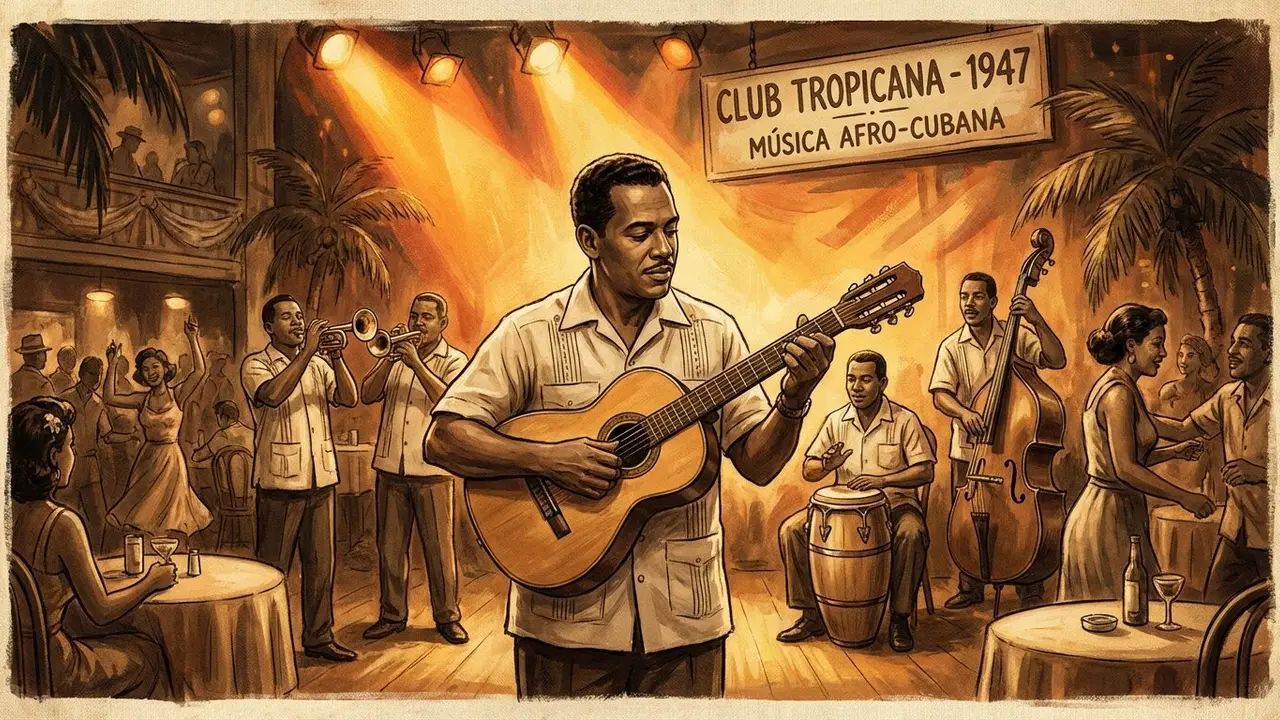
Arsenio Rodríguez: The Blind Marvel Who Revolutionized Cuban Music
In the history of Cuban music, few figures burned as bright as Arsenio Rodríguez (1911–1970). Blind since the age of seven, this genius of the Cuban tres forever transformed the island’s musical landscape by creating the conjunto format, developing son montuno, and laying the groundwork for what the world would come to know as salsa.
His nickname says it all: El Ciego Maravilloso — The Blind Marvel.
From Güira de Macurijes to the World
Ignacio Arsenio Travieso Scull was born on August 31, 1911, in Güira de Macurijes, a small town in Matanzas Province — the same land that gave the world the danzón and rumba. He was the third of fifteen children in a family of Kongo descent, deeply rooted in the traditions of Palo Monte.
At age seven, tragedy struck: a horse kicked him in the head, completely destroying his optic nerves. Far from surrendering, his blindness pushed him toward music with fierce determination.
Afro-Cuban Roots
In Güines, where he grew up, young Arsenio immersed himself in Afro-Cuban musical traditions. Alongside his brother Israel “Kike,” he played tumbadora at rumbas in Matanzas and participated in Palo Monte and Santería ceremonies. These experiences with sacred African rhythms — the drumming for Changó, Yoruba chants, yuka percussion — became the DNA of his music.
He first learned the marímbula and botija, rustic instruments of the rural rhythm section, before taking up the tres — the instrument that would make him immortal.
Bruca Maniguá: The Hit That Changed Everything
In 1937, the Orquesta Casino de la Playa recorded his composition “Bruca Maniguá” featuring vocalist Miguelito Valdés. The song, partially sung in the Kongo language, was an international hit that broke barriers: it was African music in essence, presented to the Cuban mainstream without apology or compromise.
The lyrics — “Bruca maniguá, ¡ae! yo son carabalí, negro de nación” — were a declaration of Afro-Cuban pride at a time when Black culture was frequently marginalized.
The Conjunto Revolution
In 1940, Arsenio took the step that would transform Cuban music forever: he formed his own conjunto. While traditional septetos used 6-7 musicians, Arsenio’s conjunto expanded the lineup to 8-12 members:
- Tres (Arsenio as leader)
- Piano (the legendary Lilí Martínez)
- Two trumpets (a key innovation)
- Double bass
- Tumbadora (conga drum — another innovation)
- Bongó with cowbell during montunos
- Three vocalists (chorus and lead)
- Claves, maracas, and guitar
This formation became the standard for Cuban popular music and, decades later, the model that New York salsa would adopt.
Who Invented the Mambo?
One of Cuban musicology’s most passionate debates: who created the mambo? Arsenio always claimed paternity. In the early 1940s, he introduced intense instrumental sections he called “diablo” into his arrangements — passages where the trumpets and rhythm ignited with explosive energy.
Antonio Arcaño and his charanga also developed something similar around the same time. And it was Pérez Prado who, from Mexico, commercially popularized the term “mambo” worldwide.
The truth is that Arsenio provided the rhythmic and harmonic foundations that made both the mambo and cha-cha-chá possible.
Life Is a Dream
In 1947, Arsenio traveled to New York hoping to regain his sight. The renowned Spanish ophthalmologist Ramón Castroviejo delivered devastating news: his optic nerves were completely destroyed. There was no cure.
From that pain was born one of Cuban music’s most beautiful boleros: “La vida es un sueño” (Life Is a Dream) — “La vida es un sueño y todo se va…” A song that transcends its personal context to become a universal reflection on loss and acceptance.
The Legacy: From Son Montuno to Salsa
What made Arsenio truly revolutionary was his ability to integrate the deepest elements of Afro-Cuban music — Palo Monte rhythms, Kongo chants, sacred percussion — into a danceable, accessible format. The son montuno he developed became the template that future generations would use:
- Celia Cruz sang his compositions
- Benny Moré absorbed his direct influence
- Tito Puente and Machito built on his format in New York
- The Fania All-Stars acknowledged their debt to Arsenio
- Cuban timba carries his rhythmic DNA
When he permanently moved to New York in 1952, he left his conjunto in the hands of trumpeter Félix Chappottín, who continued the tradition as Conjunto Chappottín.
The Final Years
In New York, Arsenio continued recording and composing, but he never achieved the commercial success he deserved. The American music industry didn’t know what to do with a blind genius who sang in Spanish and played an instrument nobody recognized.
In 1970, he moved to Los Angeles, where he died of pneumonia on December 30, at age 59. He passed away in relative obscurity, far from the island of his birth.
A Belated Recognition
Today, musicologists and artists unanimously recognize Arsenio Rodríguez as one of the most important musical figures of the 20th century. Without his vision — an ironic word for a blind man — salsa as we know it would not exist. Timba would not exist. The conjunto format that dominates Latin music would not exist.
His grave at Ferncliff Cemetery in New York bears a simple inscription. But his music lives on every time a conga strikes leather, a tres strums a montuno, and a voice shouts “¡Diablo!” over the horns.
Arsenio didn’t need eyes to see what Cuban music could become.
Frequently asked questions
Why was Arsenio Rodríguez called El Ciego Maravilloso?
What instrument did Arsenio Rodríguez play?
What is the connection between Arsenio Rodríguez and salsa?
Did Arsenio Rodríguez invent mambo?
How we got here
Background
The first thing we published on this topic.
Cuban Music Conquers the Latin Grammys
Cuban artists sweep the ceremony with awards in multiple tropical music categories.
Son Cubano: The Rhythm That Conquered the World
From the mountains of Oriente to Broadway stages. History, instruments, and legends of the musical genre that defines Cuba.
Related articles
Ernesto Lecuona: The Cuban Gershwin Who Conquered the World
Life and legacy of Ernesto Lecuona, Cuba's most prolific composer with over 600 works that defined Latin music worldwide.
Alden Knight (1936-2026): Farewell to a Legend of Cuban Art
Cuba mourns Alden Knight, actor of film, theater, radio, and TV who dedicated six decades to performing arts. National Television Award winner.
Pedrito Martínez & Alfredo Rodríguez: Duologue Conquers the US
The Cuban conguero and pianist, from opposite paths but shared souls, triumph together on US tour.
Las Parrandas de Remedios: Cuba's UNESCO Heritage Festival
Discover Las Parrandas de Remedios, the Caribbean's oldest festival with 200+ years of history. UNESCO Heritage since 2018.
Fernando Hechavarría Wins Cuba's National Theater Prize After 50 Years
The Holguín-born actor receives Cuba's highest theater honor for a career spanning Teatro Escambray to Teatro El Público.
Carnival of Santiago de Cuba: The Caribbean's Oldest Street Party
History, traditions, and magic of the Santiago de Cuba Carnival — from colonial mamarrachos to the congas that shake the streets every July.