The Billion-Dollar Business Behind Nicaragua's Cuban Migration Route
How Ortega's regime turned Cuban migration into a massive business with charter flights, visa exemptions, and per-migrant fees worth thousands.
3 min read
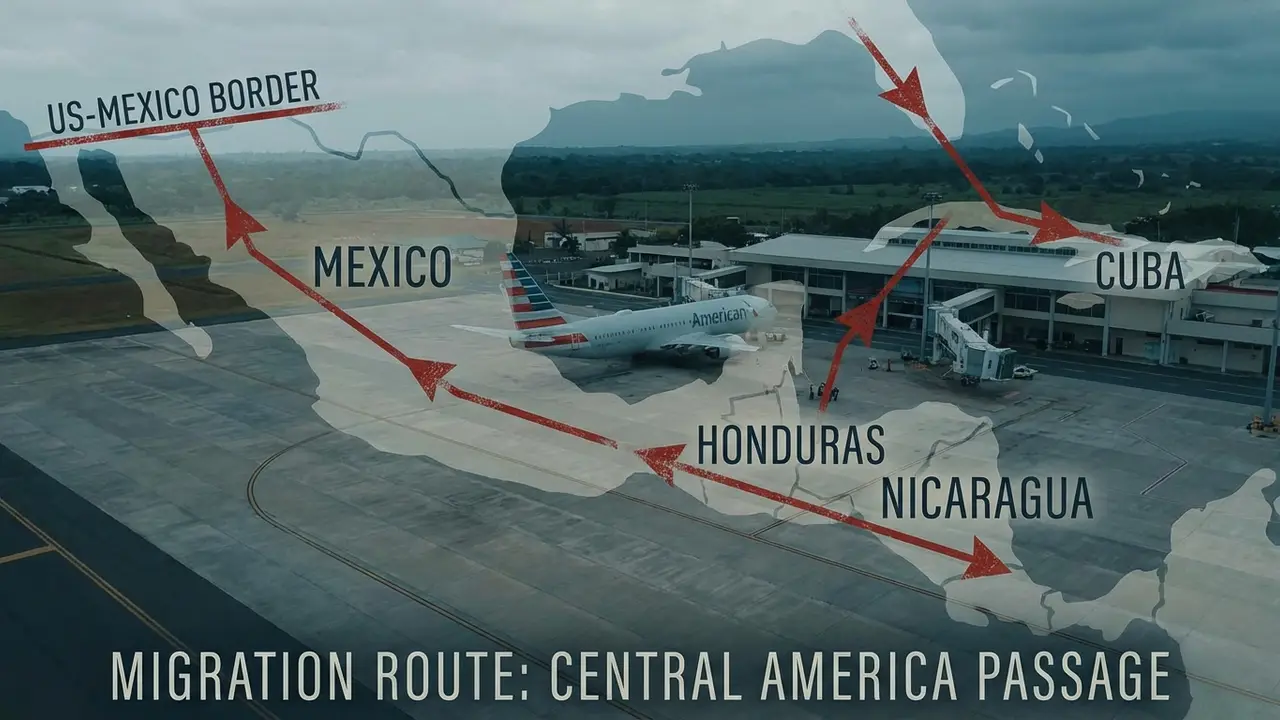
Illustration: Aroma de Cuba (AI)
For over four years, Managua’s Augusto C. Sandino airport served as the gateway to a multimillion-dollar operation: the transit of thousands of Cuban migrants heading to the United States. Now that Nicaragua closed that route on February 8, an investigation by Infobae reveals the true scale of the system that Daniel Ortega and Rosario Murillo’s dictatorship built around irregular migration.
How the “Springboard” Worked
On November 22, 2021, the Ortega regime established visa-free entry for Cuban citizens under “humanitarian” pretexts following the COVID-19 pandemic. What appeared to be a gesture of solidarity became a well-oiled migration corridor.
The system operated like this:
- Direct flight from Havana to Managua (or via Panama on Conviasa)
- Visa-free entry into Nicaraguan territory
- Overland journey through Honduras, El Salvador, Guatemala, and Mexico
- Crossing to the U.S. southern border
Airlines multiplied their routes. Conviasa, Venezuela’s state-owned airline, resumed Havana-Managua flights in December 2021 with weekly service. But the real volume came from charter flights: over 500 between January and October 2023, averaging 50 flights per month.
The Numbers Behind the Business
Manuel Orozco, director of the Migration, Remittances and Development program at the Inter-American Dialogue, has closely monitored this phenomenon. His data reveals an enormously profitable operation:
- Migrants arriving by air: between $1,500 and $2,000 paid to the regime in safe-conduct passes, visas, and taxes
- Migrants crossing by land: $150 to transit the country from border to border
The impact on migration figures was immediate and dramatic. According to data presented to the U.S. Congress, Cuban encounters at the southern border jumped from 39,303 in 2021 to over 224,000 the following year — an increase of more than 470%.
Migration as a Political Weapon
Orozco doesn’t mince words: the Nicaraguan regime “weaponized” irregular migration as an attack on U.S. national security. Cubans represented approximately 10% of all irregular migration reaching the Mexico-U.S. border in 2023.
It wasn’t just Cubans. The route also attracted migrants from Africa and Asia who used Managua as a transit point, further expanding the corridor’s reach — and profits.
The Closure and Its Consequences
Nicaragua’s new regulation (002-2026) now requires consulted visas for citizens of 128 countries, including allies like Cuba, China, and Venezuela. Applications are processed online through the Ministry of the Interior and require in-person consular stamping.
Conviasa temporarily suspended its Managua flights after learning of the measure. For the thousands of Cubans who used this route each month, the closure comes at the worst possible time: with Cuba’s economic crisis deepening, the CHNV program canceled, and deportations from the U.S. increasing.
What Options Remain?
With Nicaragua closed, options for Cubans seeking to emigrate have shrunk dramatically:
- Direct flights to Mexico: increasingly monitored and expensive
- The Darién Gap route: extremely dangerous with tighter controls
- Visas to third countries: Guyana, Suriname, and other destinations that still don’t require Cuban visas
- By sea: the historic risk of the Florida Straits
The era of Nicaragua’s migration “springboard” is over, but the pressure driving Cuban migration won’t disappear. It will simply find new channels.
Sources: Infobae, Inter-American Dialogue, U.S. Congress, Nicaragua Ministry of the Interior
Frequently asked questions
How much money did Nicaragua make from each Cuban migrant?
How many charter flights operated between Cuba and Nicaragua?
When did Nicaragua close visa-free entry for Cubans?
How did the Nicaraguan route affect Cuban migration numbers?
Sources
- Infobae · infobae.com
How we got here
Background
The first thing we published on this topic.
Nicaragua Closes the Door: Ends Visa-Free Entry for Cubans
Nicaragua ends visa-free entry for Cuban citizens, closing one of the main migration routes to the United States.
Cuban man's death in ICE custody ruled homicide by medical examiner
Geraldo Lunas Campos died at Camp East Montana after being asphyxiated by guards according to official autopsy.
Related articles
Cubana de Aviación Slashes Madrid Route to Just One Weekly Flight
Cuba's national airline drastically cuts European service as NOTAM confirms no jet fuel at Cuban airports until March 2026.

Judge Frees Three Cubans Convicted of Murder from ICE Custody
A Louisiana judge ordered the release of three Cuban nationals with murder convictions from ICE detention, ruling Cuba unlikely to accept them.

ICE Arrests Five Cuban Nationals with Criminal Records in U.S.
ICE agents detained five Cuban citizens convicted of murder, assault, and drug trafficking across multiple states for deportation.
Cuban man's death in ICE custody ruled homicide by medical examiner
Geraldo Lunas Campos died at Camp East Montana after being asphyxiated by guards according to official autopsy.
Nicaragua Closes the Door: Ends Visa-Free Entry for Cubans
Nicaragua ends visa-free entry for Cuban citizens, closing one of the main migration routes to the United States.
Cuban Hospital Couple Freed from ICE: Unions Paid Their $20K Bond
A Cuban gay couple at SUNY Upstate in Syracuse NY spent 4 months in ICE detention before their unions raised $20,000 in bail money to free them.