Nicolás Guillén: The Poet Who Made Cuban Son Sing
Discover the life and work of Nicolás Guillén, Cuba's National Poet who fused African rhythms with poetry to create the Afro-Cuban movement.
3 min read
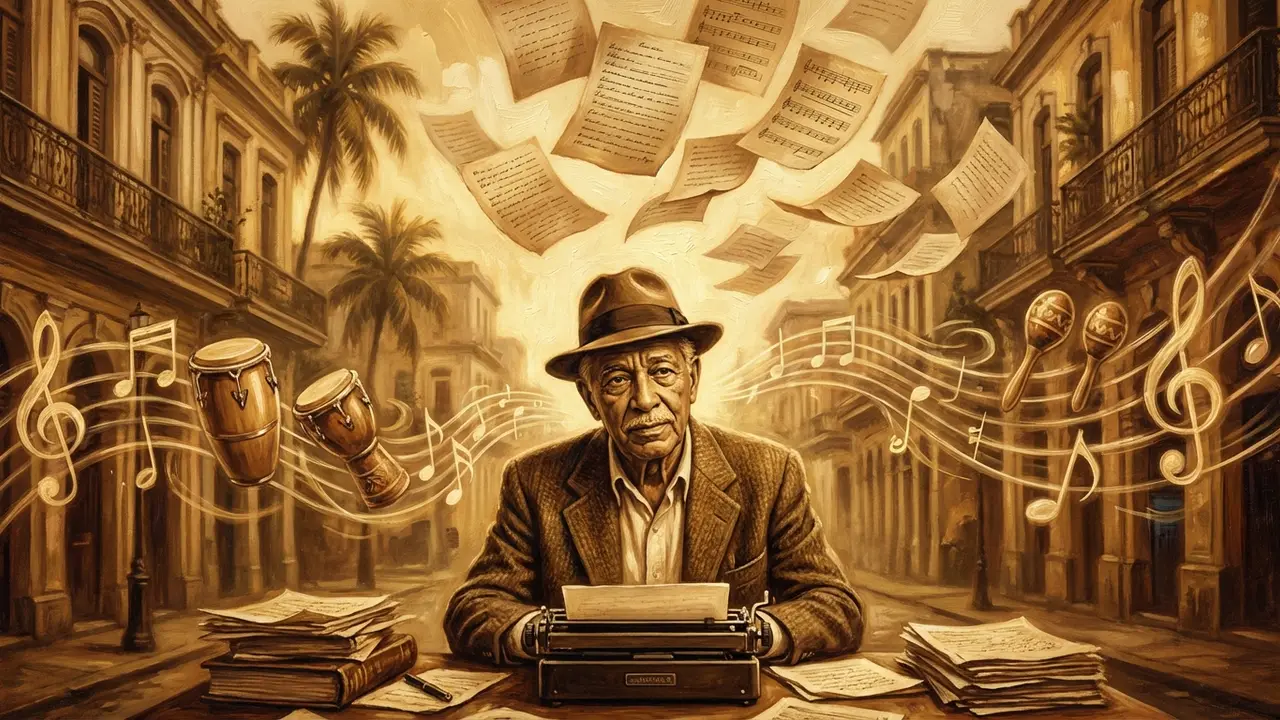
Illustration: Aroma de Cuba (AI)
In Havana of 1902, a mulatto child was born who would forever change Latin American literature. Nicolás Cristóbal Guillén Batista would become not only Cuba’s National Poet but the voice that made words dance to the rhythm of the African drum.
The Birth of a Unique Voice
Guillén grew up in Camagüey, in a middle-class mulatto family. His father, Nicolás Guillén Urra, was a journalist and senator, but was killed when the poet was just 15 years old. This early loss would profoundly mark his work and his commitment to social justice.
He studied Law in Havana, but poetry called to him more strongly. In the 1920s, while the island vibrated with the rhythms of Cuban son, Guillén searched for a way to capture that energy in verse.
Motivos de Son: The Poetic Revolution of 1930
On April 20, 1930, the Diario de la Marina published something that scandalized Havana’s literary elite: eight poems titled Motivos de Son (Son Motifs). For the first time, Cuban poetry spoke as the Black people of Havana’s tenements spoke:
Why do you get so angry,
when they call you thick-lipped Black,
if your mouth is blessed,
thick-lipped Black?
These verses incorporated the musical structure of son: an initial theme and a repeating refrain, as explained by Conexos magazine. It was poetry meant to be sung, recited with the body, danced with words.
Poetic Mestizaje
A year later came Sóngoro Cosongo (1931), where Guillén defined his vision of the mulatto as a symbol of true Cuban identity. It wasn’t just racial mixing—it was cultural fusion, a synthesis of worlds:
Here, whoever is finest,
answers when I call.
According to Wikipedia, Guillén created what he called “mestizo poetry”—a synthesis between white and Black cultural elements that defined authentic Cuban-ness.
Sensemayá: When Words Become Drums
Perhaps no poem better exemplifies Guillén’s genius than Sensemayá (1934), a poetic spell for killing a snake that reproduces Afro-Cuban ritual rhythms:
¡Mayombe—bombe—mayombé!
¡Mayombe—bombe—mayombé!
¡Mayombe—bombe—mayombé!
Onomatopoeia becomes music, words become percussion. This poem has been set to music countless times, from symphonic versions to Latin jazz interpretations.
Commitment and Exile
Guillén’s poetry was never just aesthetic—it was political. West Indies, Ltd. (1934) denounced economic imperialism in the Caribbean. His ideas led him to exile between 1953 and 1959, years he spent in Paris, Buenos Aires, and Moscow.
With the triumph of the Revolution, he returned to Cuba and was named National Poet in 1961. He presided over the Union of Cuban Writers and Artists (UNEAC) until his death in 1989.
Living Legacy
Guillén’s influence transcends literature:
- In music: Artists like Compay Segundo and Celia Cruz have set his verses to music
- In Latin hip-hop: Cuban rappers like Orishas cite his influence
- In academia: He is studied in universities worldwide as a pioneer of the negrismo movement
Why It Matters Today
In times when identities fragment, Guillén reminds us that Cuban culture—like Latin American culture—is born from encounter. His verses remain an antidote to racism and a hymn to diversity.
As he wrote in his poem La Muralla (The Wall):
—Knock, knock.
—Who’s there?
—A rose and a carnation…
—Open the wall!
The wall that Guillén opened was that of Cuban literature, letting in forever the drum, the son, and the voice of the Afro-Cuban people.
Want to explore more about Cuban music that has conquered the world? Keep reading at Aroma de Cuba.
Frequently asked questions
Why is Nicolás Guillén considered Cuba's National Poet?
What are the Motivos de Son?
What awards did Nicolás Guillén receive?
What is Guillén's most famous poem?
How we got here
Background
The first thing we published on this topic.
Cuban Music Conquers the Latin Grammys
Cuban artists sweep the ceremony with awards in multiple tropical music categories.
Old Havana Restoration Reaches a New Milestone
Rehabilitation work in the historic quarter reveals colonial frescoes from the 18th century.
Related articles
Nicolás Guillén: Cuba's National Poet and the Afro-Cuban Voice
Discover the life and work of Nicolás Guillén, the poet who fused son music with poetry and gave voice to Afro-Cuban identity.

Roberto Salas: The Photographer Who Immortalized the Cuban Revolution
Roberto Salas receives Cuba's 2025 National Prize for Visual Arts for his work capturing six decades of Cuban history.
No Seasoning: Afro-Cuban Outsider Art Arrives in Miami
Historic exhibition brings together seven Afro-descendant Cuban outsider artists in North Miami. Features works by Luis Manuel Otero Alcántara.
Changüí of Guantánamo: The Forgotten Root of Cuban Son
Discover changüí, the 200-year-old musical genre born in Guantánamo's sugar cane fields that gave birth to Cuban son.
New Cuban Cinema: ICAIC Gems That Defined a Generation
Discover the most influential Cuban films from the 60s-80s: Memories of Underdevelopment, Lucía, I Am Cuba, and Strawberry and Chocolate.
TITOVERSE: Cuba Launches Its First Animated Superhero Series
ICAIC debuts TITOVERSE: Genesis, Cuba's first animated superhero series aiming to capture global audiences with Cuban identity.