Pepe Sánchez: The Santiago Tailor Who Invented the Cuban Bolero
Meet José Pepe Sánchez, the trovador from Santiago who created the bolero and founded Cuban trova without ever reading music.
4 min read
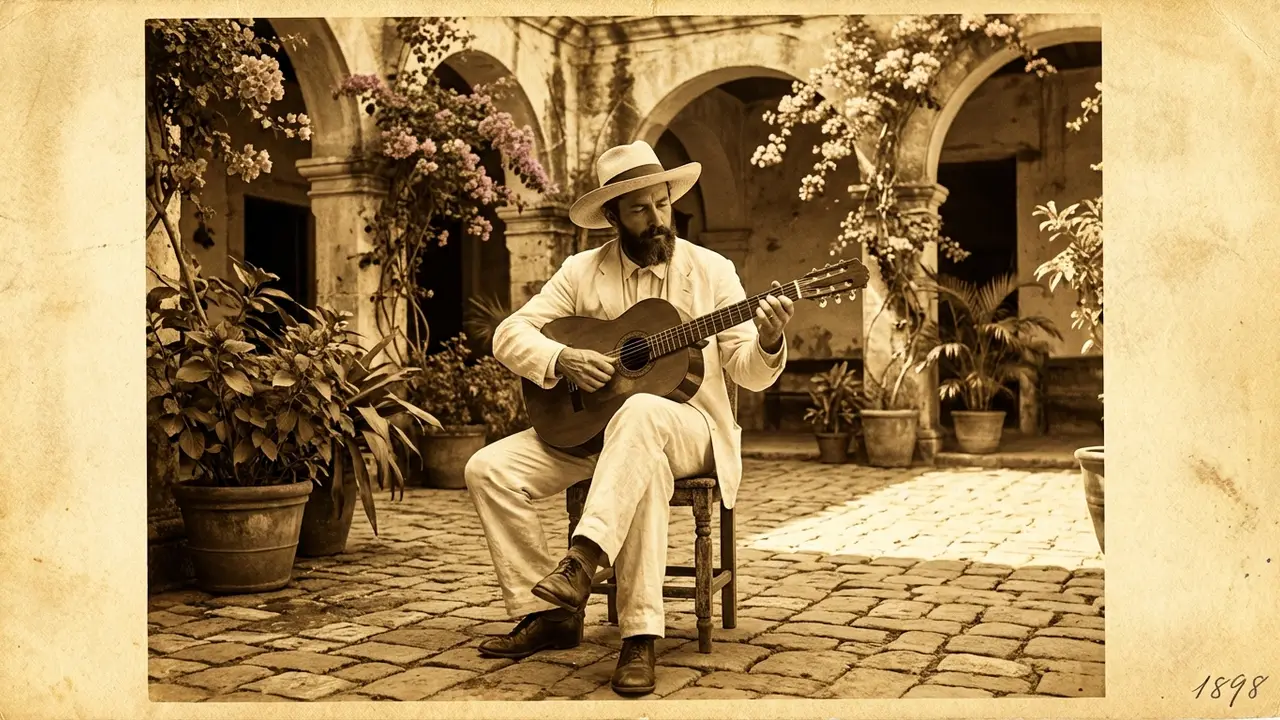
Illustration: Aroma de Cuba (AI)
In a humble tailor shop in Santiago de Cuba in the mid-19th century, a young mulatto man stitched suits while humming melodies no one had ever heard before. He couldn’t read music, never wrote a score, but José “Pepe” Sánchez was about to invent a genre that would conquer all of Latin America: the bolero.
The tailor who composed from memory
Born on March 19, 1856, Pepe Sánchez was a man of fascinating contradictions. A mulatto in a stratified colonial society, he managed to move effortlessly among Santiago’s upper classes thanks to his talent and charisma. He started as a tailor, later became co-owner of a copper mine, and served as the local representative for a Jamaican textile company.
But his true calling was music. Although he never had formal training—just some experience in Cuban bufo theater—he possessed extraordinary natural talent. He composed complete songs in his head and kept them only in his memory. He never wrote them down.
“Most of his compositions were lost forever. Only about two dozen survive, thanks to friends and disciples who transcribed them.”
Tristezas: the birth of the bolero
In 1883, Pepe Sánchez composed “Tristezas” (Sorrows), a song that musicologists recognize as the first bolero in history. With its slow tempo, its lyrics of painful love, and its Spanish guitar accompaniment, it established the characteristics that would define the genre for over a century.
“Me entristeces, mujer…” (You sadden me, woman…) began the song that would revolutionize Latin American popular music.
Unlike the Spanish bolero—an 18th-century dance—Pepe Sánchez’s Cuban bolero was intimate, confessional, made for singing serenades beneath Santiago’s balconies. It was music for trovadores, for men who wandered the streets with their guitars, earning their living through songs.
The master of the greats
What distinguishes Pepe Sánchez isn’t just his work—of which songs like “Cuba, mi patria querida” (Cuba, My Beloved Homeland), “Himno a Maceo” (Hymn to Maceo), and “Pobre artista” (Poor Artist) survive—but his legacy as a teacher. He trained the generation of trovadores who would take Cuban music to the world:
-
Sindo Garay (1867-1968): The longest-lived and most prolific, author of Perla marina and Mujer bayamesa. He boasted of having shaken hands with both José Martí and Fidel Castro.
-
Manuel Corona (1880-1950): Started playing in Havana’s red-light district and became a composer after losing hand mobility from a knife wound.
-
Rosendo Ruiz (1885-1983): Author of Cuba’s most influential guitar manual.
-
Alberto Villalón (1882-1955): Guitar technique innovator and precursor to son septets.
These four, along with Pepe Sánchez, are known as “the five greats of trova.”
Traditional trova vs. Nueva Trova
It’s important to distinguish Pepe Sánchez’s traditional trova from the Nueva Trova of the 1960s and 70s. While Silvio Rodríguez and Pablo Milanés used song as a political vehicle, the original trovadores sang of love, homeland, and heartache.
Pepe Sánchez’s trova was romantic in the purest sense: music for wooing, for saying goodbye, for suffering from love under Santiago’s stars. His direct heirs include Compay Segundo, Eliades Ochoa, and the worldwide phenomenon of the Buena Vista Social Club.
The Pepe Sánchez Festival: 60 years of tradition
Every March, Santiago de Cuba celebrates the Pepe Sánchez International Trova Festival, an event now spanning over six decades. March 19—the anniversary of the master’s birth—is considered Cuban Trovador Day.
The highlight is the Ruta del Trovador (Trovador Trail), a musical procession that ends at Santa Ifigenia Cemetery, where Pepe Sánchez, Sindo Garay, and other trova greats rest alongside figures like José Martí and Compay Segundo.
A legacy never written down
Pepe Sánchez died on January 3, 1918, in the same city where he had been born 61 years earlier. He never knew he had created a musical genre. He never imagined that his melodies—the few that survived—would be sung a century later throughout the Spanish-speaking world.
The bolero that Santiago tailor invented has crossed generations, from Mexican trios of the 1940s to today’s Latin Grammys. And it all started with a man who composed from memory, in a sewing workshop, in Cuba’s deep eastern region.
The next Pepe Sánchez International Trova Festival takes place February 26 to March 1, 2026 in Santiago de Cuba.
Frequently asked questions
Who was Pepe Sánchez and why is he important to Cuban music?
What was the first bolero ever written?
What is the Pepe Sánchez International Trova Festival?
How we got here
Background
The first thing we published on this topic.
Cuban Music Conquers the Latin Grammys
Cuban artists sweep the ceremony with awards in multiple tropical music categories.
Son Cubano: The Rhythm That Conquered the World
From the mountains of Oriente to Broadway stages. History, instruments, and legends of the musical genre that defines Cuba.
Related articles
The Cuban Bolero: The Music of Love Born in Santiago de Cuba
Discover the history of the Cuban bolero, from Pepe Sánchez to Olga Guillot. How this romantic genre conquered Latin America.
Buena Vista Social Club Wins Grammy: Broadway Celebrates Cuba
The Broadway musical about legendary Cuban musicians won the 2026 Grammy for Best Musical Theater Album.

Ana Mendieta at Tate Modern: Major Retrospective of Cuban Pioneer
The UK's largest Ana Mendieta retrospective opens at Tate Modern in July 2026. 150 works by the Cuban-American earth-body art pioneer.
Carnival of Santiago de Cuba: The Caribbean's Greatest Celebration
Discover the history and traditions of Santiago de Cuba's Carnival, a 300+ year celebration blending African and Spanish heritage in vibrant festivities.
Malpaso Dance Company: Cubans Make History with Martha Graham
The Havana-based company becomes the first Cuban troupe to perform Martha Graham's work at New York's Joyce Theatre.
Jazz Plaza 2026: Havana Beats to Jazz Rhythms Amid Crisis
Jazz Plaza celebrated its 40th edition in Havana (Jan 25-Feb 1) with 286 international artists, proving Cuban music endures despite blackouts.