The Protest of Baraguá: When Maceo Said No to Surrender
On March 15, 1878, Antonio Maceo rejected the Pact of Zanjón at Baraguá. The story of the bravest act in Cuba's independence wars.
5 min read
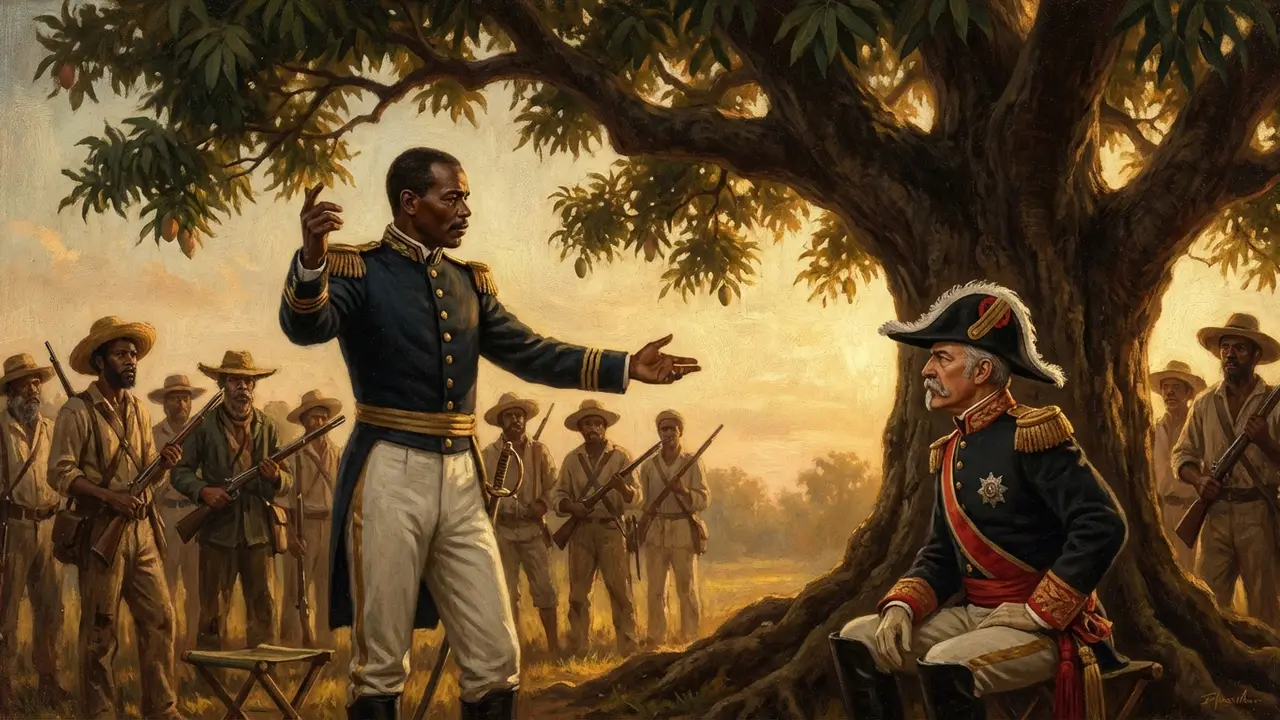
Illustration: Aroma de Cuba (AI)
On March 15, 1878, at a place called Mangos de Baraguá in eastern Cuba, one of the most defining moments in Cuban history unfolded. General Antonio Maceo, just 32 years old, stood before Spanish Captain General Arsenio Martínez Campos and delivered a message that would change the course of a nation: we do not accept this peace.
It was an act of courage that José Martí would later immortalize as “the most glorious moment in our history.”
The Ten Years’ War: A Decade of Blood
To understand Baraguá, you have to go back to October 10, 1868, when Carlos Manuel de Céspedes launched the Grito de Yara and began the Ten Years’ War against Spanish rule.
For a decade, the mambises — Cuba’s independence fighters — battled with machetes, captured rifles, and unbreakable determination. The war claimed more than 200,000 lives on both sides.
But by 1878, the movement was fractured:
- Internal divisions between political and military leaders
- Exhaustion after ten years of conflict
- Lack of resources and weapons
- Racial tensions: many white leaders distrusted the growing influence of Black and mixed-race officers
The Pact of Zanjón: Peace Without Justice
On February 10, 1878, the Pact of Zanjón was signed between representatives of the insurgent government and General Martínez Campos. Spain offered:
- General amnesty for all combatants
- Freedom for enslaved people who had fought in the mambí army
- Political reforms similar to those in Puerto Rico
But the pact did not include the essentials:
- ❌ No guarantee of independence for Cuba
- ❌ No complete abolition of slavery (only for those who had fought)
- ❌ No real representation in the colonial government
For most leaders in eastern Cuba — where the war had been fiercest and where the Black and mixed-race population was the majority — this peace was a betrayal.
The Meeting at Mangos de Baraguá
Martínez Campos, confident he could convince Maceo as he had convinced others, requested a meeting. It was set for March 15, 1878 at Mangos de Baraguá, near Santiago de Cuba.
Maceo arrived with his officers. Martínez Campos came with his staff and an interpreter — a telling detail, since Maceo spoke perfect Spanish. The Spanish general expected a negotiation; what he got was a declaration.
The Words That Changed History
Maceo listened to the terms of the pact and responded with absolute clarity:
“We are not satisfied”
He declared that neither he nor his troops would accept a peace that did not include total independence and the complete abolition of slavery. He informed Martínez Campos that hostilities would resume in eight days.
The Spanish general was stunned. He had underestimated Maceo — as many others would.
Antonio Maceo: The Bronze Titan
To grasp the magnitude of Baraguá, you need to know the man behind the protest.
Antonio Maceo Grajales was born on June 14, 1845 in Santiago de Cuba, the son of Marcos Maceo, a Venezuelan mestizo, and Mariana Grajales, a free Black woman who would become known as the Mother of the Nation.
Maceo joined the war from its very first day in 1868. By 1878 he was:
- Lieutenant General of the Liberation Army
- A veteran of over 500 battles
- Bearer of 26 war wounds
- A leader respected by white, Black, and mixed-race soldiers alike
He was called the Bronze Titan — not just for his skin color, but for his superhuman endurance in combat. On one occasion, gravely wounded, he reportedly cut a bullet from his own body with his knife to keep fighting.
The Deeper Meaning
The Protest of Baraguá was far more than a military act. It was a declaration of principles with multiple dimensions:
Racial Dignity
Maceo, a Black man in a slave-holding society, told the representative of an empire that ruled half the world that his terms were not good enough. In an era when slavery was still legal in Cuba, this act defied not only colonial power but the entire racial structure of society.
Revolutionary Resolve
Baraguá established a principle that would mark Cuban politics: fundamental rights are not negotiable. Either complete independence, or keep fighting.
Unity in Diversity
The officers who accompanied Maceo were white, Black, and mixed-race. The protest demonstrated that the Cuban cause transcended the racial divisions Spain tried to exploit.
After Baraguá
Maceo attempted to continue the fight, but military reality was unforgiving. Without resources, without external support, and with most of the army demobilized, he had to leave Cuba temporarily. He spent years in exile — Jamaica, Haiti, Honduras, Costa Rica — always planning the return.
The Little War of 1879-1880 was a failed attempt to reignite the struggle. But the seed of Baraguá grew into something greater.
When Martí organized the Necessary War of 1895, Maceo was among the first to answer the call. His Invasion from East to West — a military march of over 1,000 kilometers across the entire island — remains one of the most impressive feats in Caribbean military history.
Maceo fell in combat on December 7, 1896 at San Pedro, Punta Brava, near Havana. He was 51 years old and fighting on the front line, as always.
A Legacy That Endures
The Protest of Baraguá transcended its historical moment. It became a permanent symbol of Cuban resistance:
- March 15 is commemorated every year in Cuba
- The monument at Mangos de Baraguá is a place of pilgrimage
- Maceo’s words — “we are not satisfied” — have been invoked in every moment of national crisis
- Martí wrote that Baraguá was where “the full character of the revolution” was revealed
As Fernando Ortiz, Cuba’s great anthropologist, noted: Maceo didn’t just protest against an unjust pact — he protested against injustice itself.
Under the mango trees of eastern Cuba, a man of bronze said no to an empire. And Cuba was never the same.
You may also like: Hatuey: the Taíno Chief Who Became Cuba’s First National Hero
Frequently asked questions
What was the Protest of Baraguá?
Why did Antonio Maceo reject the Pact of Zanjón?
What is the historical significance of the Protest of Baraguá?
Who was Antonio Maceo and why was he called the Bronze Titan?
How we got here
Background
The first thing we published on this topic.
Old Havana Restoration Reaches a New Milestone
Rehabilitation work in the historic quarter reveals colonial frescoes from the 18th century.
Governments Issue Travel Warnings for Cuba Amid US Tensions
Canada, Argentina, Spain and other countries warn citizens about Cuba's crisis as Washington's oil blockade and prolonged blackouts affect the island.
Related articles
Jardines de la Reina: the Caribbean's best diving is in Cuba
Discover Jardines de la Reina, Cuba's protected archipelago with sharks, pristine reefs, and world-class diving.
The Cuban Bolero: UNESCO Heritage and the Universal Language of Love
From Santiago de Cuba to the world, the bolero was born as a love song and is now a UNESCO Heritage. Its history, voices, and lasting power.
Trinidad, Cuba: essential guide to Cuba's most beautiful city
Complete guide to Trinidad, Cuba. What to see, where to stay, casas particulares, nearby beaches and tips to explore this UNESCO gem.
The Cuban Bolero: The Music of Love Born in Santiago de Cuba
Discover the history of the Cuban bolero, from Pepe Sánchez to Olga Guillot. How this romantic genre conquered Latin America.
Hatuey: the Taíno Chief Who Became Cuba's First National Hero
The story of Hatuey, the Taíno cacique who resisted Spanish conquest and was burned alive in 1512. Cuba's first national hero.
Camagüey: a guide to getting lost in Cuba's most beautiful maze
Discover Camagüey, Cuba's labyrinth city. A guide to its plazas, churches, tinajones, casas particulares, and tips for your visit.