Alejo Carpentier and Lo Real Maravilloso: Cuba's Literary Giant
Life and legacy of Alejo Carpentier, father of the marvelous real and key figure of the Latin American boom. His work transformed world literature.
4 min read
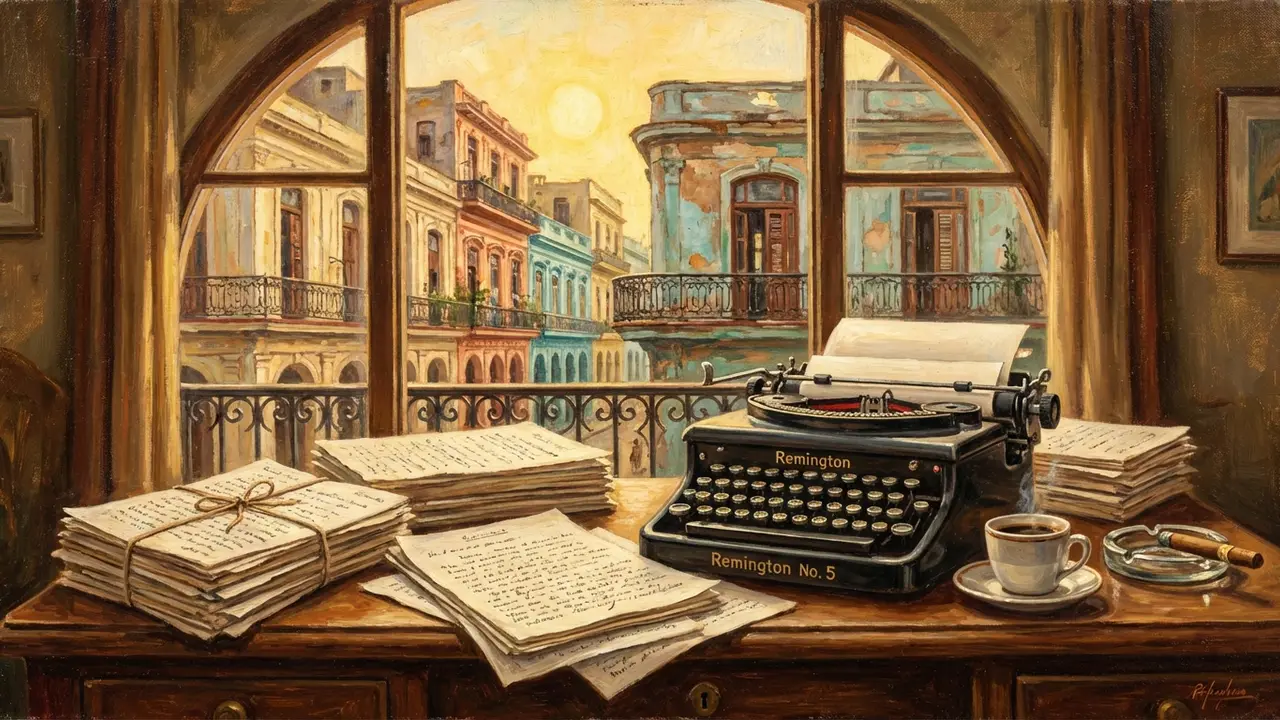
Illustration: Aroma de Cuba (AI)
Some writers narrate their country. Others invent the way an entire continent tells its story. Alejo Carpentier (1904–1980) belonged to the second category: the man who looked at Latin American reality and discovered it was more fantastic than any European fiction.
From Lausanne to Havana: The Early Years
Though born in Switzerland — son of a French architect and a Russian teacher — Carpentier grew up on the streets of Havana. The colonial city, with its baroque architecture, Afro-Cuban rituals, and ceaseless music, became the laboratory where he forged his worldview.
He briefly studied architecture at the University of Havana, but journalism and literature soon claimed him. In the 1920s, he co-founded the Revista de Avance and immersed himself in the Afro-Cubanist movement alongside Nicolás Guillén and composer Amadeo Roldán.
Parisian Exile and Surrealism
In 1928, after being imprisoned by the Gerardo Machado regime, Carpentier escaped to Paris on forged documents. He spent eleven years among the Surrealists — André Breton, Robert Desnos, Antonin Artaud — but soon realized European Surrealism fell short.
“The marvelous begins to be unmistakably marvelous when it arises from an unexpected alteration of reality, an unaccustomed illumination.”
That sentence, from the prologue to The Kingdom of This World, became his manifesto.
Lo Real Maravilloso: The Great Revelation
In 1943, Carpentier traveled to Haiti and visited the ruins of Henri Christophe’s palace at Sans-Souci. Before those stones — testimony of a Black king who built a tropical Versailles — he understood something definitive: Latin America didn’t need to invent the marvelous because it was already living it.
Thus was born lo real maravilloso, the concept that distinguishes his work from the magical realism of García Márquez or Borges. It wasn’t a narrative technique: it was a way of seeing American reality.
His novel The Kingdom of This World (1949) — about the Haitian Revolution as witnessed by the slave Ti Noel — officially inaugurated this current.
The Masterworks
The Lost Steps (1953)
A musicologist travels from New York to the heart of the Venezuelan jungle searching for primitive instruments. What he finds is a journey backward through the history of civilization. Widely considered his masterpiece, it was translated into dozens of languages and established his international reputation.
Explosion in a Cathedral (1962)
Set in the Caribbean during the French Revolution, it narrates how the ideals of liberty, equality, and fraternity reached the Antilles through Victor Hugues. It is a monumental reflection on revolution, power, and the Caribbean’s destiny as a crossroads of history.
Baroque Concert (1974)
In barely 80 pages, Carpentier condenses centuries of encounter between America and Europe through music. A Mexican colonial lord travels to Venice and ends up at a carnival with Vivaldi, Scarlatti, and Handel. It is Carpentier at his most playful and musical.
The Musicologist
Carpentier didn’t just write about music — he understood it with academic rigor. His essay Music in Cuba (1946) remains essential reading for anyone studying the island’s musical evolution, from Yoruba chants to son cubano.
His prose itself is musical. Carpentier’s sentences are built like baroque compositions: long, ornate, with an internal rhythm that demands to be read aloud.
Cervantes Prize and Final Years
In 1977, Carpentier received the Miguel de Cervantes Prize, the Nobel of Spanish-language literature. He was the first Cuban to receive it — and remains the only one to this day.
He spent his final years in Paris as Cuba’s ambassador to France. He died on April 24, 1980, and was buried at the Colón Cemetery in Havana, the city that never stopped being his.
A Legacy That Lives On
The Alejo Carpentier Foundation, in Old Havana, preserves his personal archive — manuscripts, correspondence, photographs — and organizes the novel prize that bears his name. His house at Empedrado 215 is now a museum and cultural center.
But his greatest legacy is invisible: he changed the way Latin America tells its own story. Without Carpentier, there is no García Márquez. Without lo real maravilloso, there is no One Hundred Years of Solitude. Without his baroque ear, Latin American narrative would sound entirely different.
Small but tireless. Like the zunzún, Carpentier pollinated the literature of an entire continent. 🌺
Frequently asked questions
What is Alejo Carpentier's 'lo real maravilloso'?
What are Alejo Carpentier's most important works?
Was Alejo Carpentier Cuban or French?
What literary prize did Alejo Carpentier win?
How we got here
Background
The first thing we published on this topic.
Cuban Music Conquers the Latin Grammys
Cuban artists sweep the ceremony with awards in multiple tropical music categories.
Old Havana Restoration Reaches a New Milestone
Rehabilitation work in the historic quarter reveals colonial frescoes from the 18th century.
Related articles

Cuba Advances to Serie de las Américas 2026 Semifinals
Cuba edged Colombia 8-7 in a dramatic finish to clinch a semifinal berth, where they'll face host Venezuela in Caracas.
José Martí: Cuba's Apostle Who Built a Nation Through Poetry
Life and legacy of José Martí, Cuban national hero, modernist poet, and independence leader. From prison to the Versos sencillos.
Cuban Santería: The Religion of the Orishas and Its Power
Discover Cuban Santería, its orishas, rituals, the 2026 Letra del Año prophecy, and how this Afro-Cuban religion thrives today.
La Cosa: The Secret Language That Reveals Cuba's Soul
When a Cuban asks '¿Cómo está la cosa?', they say everything while saying nothing. Discover the coded language that defines Cuban resilience.
Cuban Timba: The Most Explosive Music Born in Havana
Discover Cuban timba, the genre that fused son, funk, and rumba in the 1990s. History, key bands, and rhythms conquering the world.
Cuban Baseball: The History of Cuba's National Passion
Discover the history of baseball in Cuba, from 1864 to today. How pelota became a symbol of identity, freedom, and national pride.