Cuban Bread: History, Recipe & the Tradition of Pan Cubano
Discover Cuban bread (pan cubano), its history from Ybor City to Havana bakeries, traditional recipe, and where to buy it.
5 min read
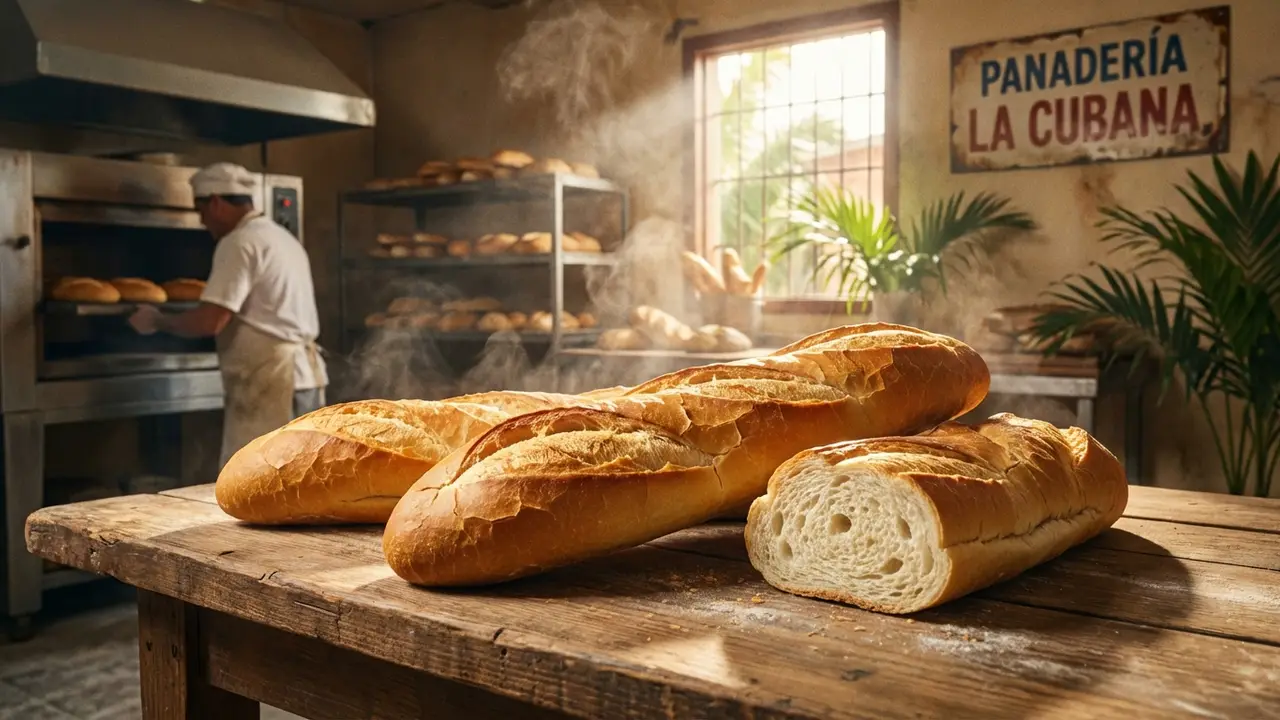
Illustration: Aroma de Cuba (AI)
The Bread at Every Cuban Table
If there’s one product that unites all Cubans — on the island and across the diaspora — it’s Cuban bread (pan cubano). That long, golden loaf with its shatteringly crisp crust and cloud-soft interior that belongs on every Cuban table.
This isn’t just any bread. Cuban bread has its own history, its own technique, and its own place in the heart of a culture where pan con timba (bread with guava paste) can be breakfast, lunch, or a snack.
A Story That Begins in Tampa
The modern history of Cuban bread is inseparable from Ybor City, Tampa’s cigar-making neighborhood. In the late 19th century, thousands of Cuban workers emigrated to Tampa to work in cigar factories, bringing their culinary traditions with them.
In 1896, Juan Moré founded La Joven Francesca Bakery, one of Tampa’s first Cuban bakeries. But it was La Segunda Central Bakery, founded in 1915 by Juan Moré Jr., that would become the most famous Cuban bakery in the United States.
To this day, La Segunda Central Bakery produces more than 18,000 Cuban bread loaves daily, distributing them throughout the southeastern United States.
The Palmetto Frond
What makes Tampa-style Cuban bread unique is the use of the saw palmetto frond. Traditionally, a palm frond is placed on top of the dough before baking. As the bread expands in the oven, the frond creates the characteristic lengthwise split that distinguishes Cuban bread from any other.
In Havana, where saw palmettos aren’t as common, bakers achieve the same effect with a knife slash before baking.
The Ingredients: Perfect Simplicity
Cuban bread is elegant in its simplicity. You only need:
- Wheat flour (preferably bread flour)
- Water
- Yeast
- Salt
- Sugar (just a touch)
- Lard — the secret ingredient
It’s the lard that separates Cuban bread from French or Italian bread. It delivers that crust that shatters when you bite into it and that crumb that practically melts in your mouth.
The Traditional Recipe
Ingredients (makes 2 loaves)
| Ingredient | Amount |
|---|---|
| Bread flour | 4 cups (500g) |
| Warm water | 1¼ cups (300ml) |
| Active dry yeast | 2¼ tsp (1 packet) |
| Sugar | 1 tablespoon |
| Salt | 1½ teaspoons |
| Lard | 2 tablespoons |
Instructions
- Activate the yeast: Dissolve yeast and sugar in warm water. Let stand 10 minutes until bubbly.
- Mix: Combine flour and salt. Add yeast mixture and melted lard. Knead 10-12 minutes until elastic.
- First rise: Cover and let rest 1-1½ hours until doubled in size.
- Shape: Divide into two portions. Form long loaves (12-16 inches) with tapered ends.
- Second rise: Place on greased baking sheet, cover with damp cloth. Let rise 45 minutes.
- Bake: Score a lengthwise slash with a sharp knife. Place a pan of water on the bottom oven rack for steam. Bake at 400°F (200°C) for 25-30 minutes until golden.
Cuban baker’s trick: Spray the oven walls with water during the first 5 minutes of baking for the perfect crust.
Legendary Cuban Bakeries
In Cuba
- Panadería Sylvain (Havana) — A Havana institution since the Republican era
- Pan de Santiago — Santiagueros swear their bread is superior to Havana’s
- State bakeries — Where subsidized bread (pan normado) remains a daily staple
In the United States
- La Segunda Central Bakery (Tampa) — The largest, since 1915
- Karla Bakery (Miami) — Multiple locations across South Florida
- Breadman Cuban Bakery (Union City, NJ) — Cuban flavor in the Northeast
Buy Online
- La Segunda on Amazon — Ships nationwide
- Goya Cuban Style Crackers — Cuban cracker alternative available at most supermarkets
Cuban Bread in the Culture
Pan con Timba
Perhaps Cuba’s most iconic food pairing: bread with guava paste (timba). Sometimes with cream cheese, sometimes alone — always perfect. Read more about Cuban guava paste in our dedicated article.
The Cuban Sandwich
Without Cuban bread, there’s no authentic Cuban sandwich. The crispy crust and soft crumb are essential for that texture contrast when pressed on the plancha with ham, roast pork, Swiss cheese, pickles, and mustard.
Pan con Lechón
Every Cuban Christmas Eve, fresh bread accompanies the roast pig. Soaked in the pork juices with mojo criollo, it’s one of the most glorious bites in Cuban cuisine.
The Ration Book
In Cuba, bread has been part of the libreta de racionamiento (ration book) since 1962. Every Cuban is entitled to one bread roll daily at a subsidized price (5 centavos CUP). State bakeries produce millions of loaves daily, though quality and availability have fluctuated over the decades.
Cuban Bread vs. Other Breads
| Feature | Cuban Bread | French Baguette | Italian Bread |
|---|---|---|---|
| Fat | Lard | None | Olive oil |
| Crust | Thin, crispy | Thick, crispy | Variable |
| Crumb | Very soft, white | Large air pockets | Dense |
| Shape | Long, tapered ends | Long, uniform | Round or oval |
| Shelf life | 1 day | 1 day | 2-3 days |
One Bread, One Identity
Cuban bread is more than a staple food — it’s an identity marker. In Miami, Tampa, New York, or Madrid, wherever there are Cubans, there are bakeries trying to replicate that flavor that connects to memory and homeland.
As a Ybor City baker once said: “Every loaf I pull from the oven is a love letter to Cuba.”
And Cuban bread, with its perfect simplicity and its crust that sings when you break it, is exactly that: love, baked.
Frequently asked questions
What makes Cuban bread different from other breads?
Where can I buy authentic Cuban bread in the United States?
How long does Cuban bread stay fresh?
Can I make Cuban bread without lard?
How we got here
Background
The first thing we published on this topic.
Cuban Coffee Harvest Promises to Be the Best in Decades
The mountains of the Sierra Maestra produce an exceptional harvest thanks to new agricultural techniques.
Ropa Vieja: The Soul of Cuban Cuisine on a Plate
Discover the history, secrets, and traditional recipe of ropa vieja, Cuba's national dish that has conquered palates around the world.
Related articles
The Cuban Sillón: History & Tradition of Cuba's Rocking Chair
Guide to the Cuban sillón, the rocking chair that defines Caribbean life. History, types, craftsmen, superstitions, and where to buy Cuban rocking chairs.
Cuban Bread: History, Recipe, and the Palmetto Leaf Secret
Discover the history of Cuban bread from Ybor City to your table. Traditional recipe, palmetto leaf technique, and where to find it.
Cuban Mojito: History, Recipe and Secrets of the Iconic Cocktail
Discover the history of the mojito, Cuba's most famous cocktail. Authentic recipe, origins, and where to try it.
Cuban Daiquiri: History of the Cocktail That Conquered the World
Discover the origins of the daiquiri in Santiago de Cuba, its perfection at Havana's El Floridita, and the original recipe of Cuba's most famous cocktail.
Cuban Coffee: History, Tradition and the Secret of the Perfect Espuma
Cuban coffee history: from Sierra Maestra to Miami. Authentic cafecito recipe with golden espuma.
Guayabita del Pinar: Cuba's Most Exclusive Artisanal Liqueur
Discover Guayabita del Pinar, the unique Cuban liqueur made from wild mini guavas. History, varieties, tasting tips, and where to find it.