The Special Period: the Crisis That Transformed 1990s Cuba
The history of Cuba's Special Period (1991-2000), the devastating economic crisis after the fall of the USSR that changed the island forever.
5 min read
When the Soviet Union collapsed in December 1991, Cuba lost far more than a political ally. It lost the economic oxygen that kept it alive. Overnight, an island that depended on the socialist bloc for 80% of its foreign trade found itself alone in the middle of the Caribbean, with an American embargo squeezing from the other side.
What followed was the most difficult decade Cubans had lived through since independence: the Special Period in Time of Peace.
A Country That Went Dark
The numbers are brutal. Between 1990 and 1993, Cuba’s GDP contracted by 35%. Imports fell by over 80%. Exports followed suit. But the numbers don’t tell the real story.
The real story is that Cuba went dark. Literally.
Soviet petroleum imports — which accounted for nearly all of Cuba’s consumption — dropped to 10% of previous levels. Without fuel, factories closed. Buses stopped running. Blackouts, which initially lasted hours, stretched to 16 hours per day. Havana, a city of over two million people, was plunged into darkness.
The Hunger
Perhaps nothing defines the Special Period better than hunger. Average caloric intake fell from 3,052 calories per day in 1989 to just 1,863 in 1993. Cubans lost an average of 5 to 25 pounds of body weight.
The ration book, which since 1962 had guaranteed subsidized basic goods, could no longer cover minimum needs. Rice, beans, cooking oil — everything was scarce. Meat virtually disappeared from the Cuban table.
People began eating whatever they could find. Fried plantain peels. Grapefruit steak — the white pith of the fruit prepared as if it were meat. Cuban inventiveness, always present, became a matter of survival.
Chinese Bicycles and Camels
Without petroleum, transportation collapsed. The government imported over one million bicycles from China between 1991 and 1993. Havana, a city designed for 1950s American automobiles, filled with cyclists.
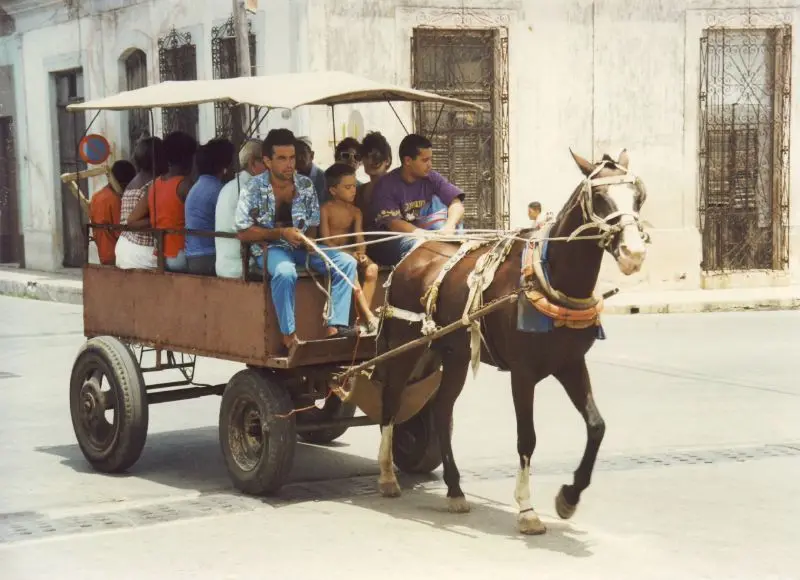
The famous “camels” appeared: enormous metal trailers pulled by truck cabs that could transport up to 300 people, crammed together in suffocating conditions. In rural areas, tractors were replaced by oxen, and horse-drawn carts returned to the roads, as shown in the image accompanying this article.
Waiting for a bus could take three hours or more. Walking miles to work became routine.
Organopónicos: Reinventing Agriculture
One of the most remarkable legacies of the Special Period was an agricultural revolution. Without chemical fertilizers, pesticides, or fuel for machinery, Cuba was forced to reinvent its farming.
Organopónicos were born: urban organic gardens that sprouted in empty lots, rooftops, and courtyards across Havana and other cities. Australian permaculturists arrived on the island to teach sustainable techniques that Cubans adopted and adapted quickly.
By 2000, Havana was producing a significant portion of its fresh vegetables within city limits. What was born out of necessity became an internationally studied model of sustainable urban agriculture.
The Maleconazo and the Rafter Crisis
Accumulated frustration exploded on August 5, 1994, when thousands of Havana residents took to the streets along the Malecón in the first mass popular protest since the Revolution’s triumph. The Maleconazo, as it became known, was quickly suppressed, but it revealed the depth of discontent.
Weeks later, Fidel Castro made an unprecedented decision: he opened the borders. What followed was the 1994 rafter crisis, a mass exodus in which over 30,000 Cubans attempted to cross the Florida Strait on improvised vessels — truck inner tubes, wooden doors, anything that would float. Images of entire families on precarious rafts under the Caribbean sun circled the globe.
The crisis led to migration agreements between Cuba and the United States, establishing 20,000 annual visas and the “wet foot, dry foot” policy.
Dollars, Jineterismo, and Double Standards
To survive, Cuba had to make ideologically unthinkable concessions. In 1993, the government legalized the possession of US dollars, creating a dual economy that divided society. Those with access to dollars — through family remittances or contact with tourists — lived in a different world from those dependent on the Cuban peso.
Tourism became the economic lifeline. But it brought with it jineterismo — the prostitution and street hustling associated with tourism — marking a painful break from the values proclaimed by the Revolution.
Cuentapropistas (self-employed workers) were authorized for the first time, and paladares — small private restaurants in family homes — began to appear tentatively, planting the seeds of a private sector that would take decades to develop.
A Legacy That Endures
The Special Period officially ended with the new millennium, when the alliance with Hugo Chávez’s Venezuela and improved relations with Russia under Putin brought economic relief. But its scars never fully healed.
It transformed Cuban society in irreversible ways:
- Inequality took root in a system that proclaimed equality
- Emigration became a widespread aspiration
- Distrust of official promises deepened
- Popular ingenuity — “resolver” (to figure it out), “inventar” (to invent), “luchar” (to fight) — became a philosophy of life
Today, with Cuba facing a new economic crisis that many compare to those terrible years, the Special Period is not just history. It is living memory, a warning, and for many Cubans, an uncomfortable mirror of the present.
As the saying born in those dark years goes: “No es fácil” — it’s not easy. Three words that sum up a decade, a generation, and the infinite resilience of a people who, against all odds, kept going.
Frequently asked questions
What was Cuba's Special Period?
How long did Cuba's Special Period last?
How did Cubans survive the Special Period?
What was the 1994 Cuban rafter crisis?
How we got here
Background
The first thing we published on this topic.
Old Havana Restoration Reaches a New Milestone
Rehabilitation work in the historic quarter reveals colonial frescoes from the 18th century.
Governments Issue Travel Warnings for Cuba Amid US Tensions
Canada, Argentina, Spain and other countries warn citizens about Cuba's crisis as Washington's oil blockade and prolonged blackouts affect the island.
Related articles
Cimarrones and Palenques: Slave Resistance in Cuba
The history of Cuban maroons who escaped slavery and built free communities called palenques in the mountains, forging a legacy of resistance.
Cuban Hip-Hop: From Alamar to the World, Cuba's Rap Revolution
The history of Cuban hip-hop from Alamar to today. How rap became the voice of a generation during Cuba's Special Period crisis.
Havana's Chinatown: 179 Years of Cultural Legacy in Cuba
The world's second-largest Chinatown outside Asia was born in Cuba in 1847. Discover its remarkable history.
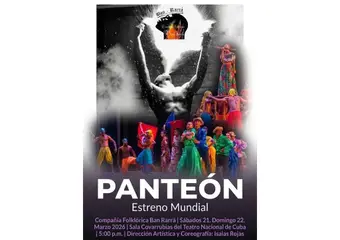
Ban Rarrá Debuts 'Panteón' at the National Theater of Cuba
The prestigious Ban Rarrá Folkloric Company presents its new work 'Panteón' on March 21st and 22nd at the Covarrubias Hall.
Callejón de Hamel: Havana's Open-Air Afro-Cuban Art Gallery
Discover Callejón de Hamel, the vibrant epicenter of Afro-Cuban art in Centro Habana with murals, sculptures, and Sunday rumba.
Varadero: complete guide to Cuba's most famous beach
Everything about Varadero: best beaches, hotels, excursions, practical tips and how to reach Cuba's most spectacular Caribbean peninsula.