Cimarrones and Palenques: Slave Resistance in Cuba
The history of Cuban maroons who escaped slavery and built free communities called palenques in the mountains, forging a legacy of resistance.
4 min read
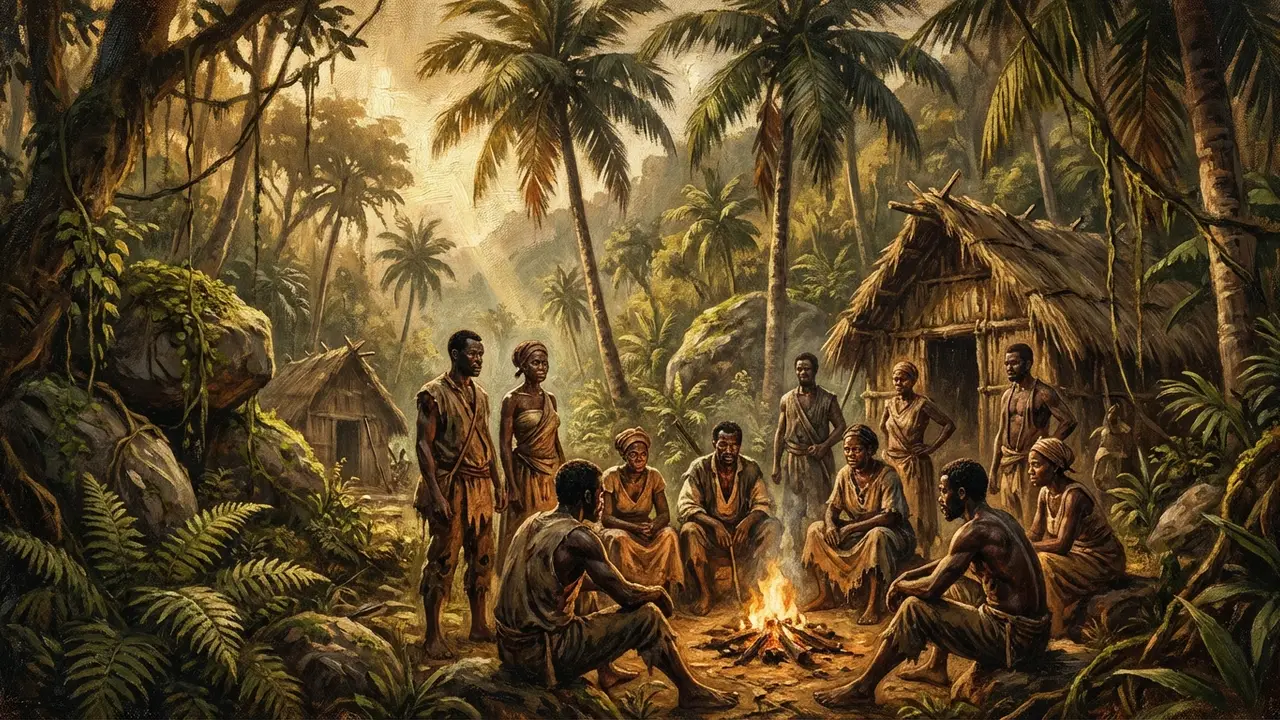
Illustration: Aroma de Cuba (AI)
In the mountains of Cuba, among centuries-old ceiba trees and impenetrable palm groves, lies one of the island’s most powerful and least told stories: that of the cimarrones — enslaved men and women who chose freedom at any cost.
From the Barracks to the Mountains
From the 16th century, when the first enslaved Africans arrived in Cuba, there were those who refused to accept their fate. The word cimarrón — from the Spanish “cima,” meaning summit — described those who fled upward, toward the mountains where rancheadores (slave hunters) couldn’t easily follow.
Slavery in Cuba was particularly brutal. Sugar mills operated as machines of exploitation where a field slave’s life expectancy rarely exceeded seven years of labor. Faced with that reality, escape wasn’t just an act of rebellion — it was an act of survival.
Palenques: Communities of Freedom
The cimarrones didn’t simply flee — they built. Deep in eastern Cuba’s mountains, they established palenques: fortified settlements surrounded by wooden palisades where they lived in community, farmed the land, raised animals, and practiced their African traditions.
Cuba’s most important palenques were located in:
- Sierra Maestra (Santiago de Cuba): Cuba’s highest mountain range sheltered thousands of cimarrones
- El Frijol (Guantánamo): one of the largest and best-organized palenques
- Sierra del Escambray (central Cuba): palenques that survived for decades
- Vuelta Abajo (Pinar del Río): in the island’s far west
These communities developed their own systems of governance, with leaders chosen for their courage and wisdom. They cultivated cassava, sweet potato, plantain, and corn — often using agricultural techniques learned from the Taíno people who had also taken refuge in the mountains.
The Cobre Rebellion: Cimarrones Who Changed History
In 1731, enslaved workers at the copper mines of Santiago de Cuba staged one of the most significant rebellions in Cuban colonial history. The cimarrones of El Cobre didn’t just escape — they demanded their freedom before the Spanish Crown and, after decades of legal struggle and armed resistance, obtained it in 1800.
This victory — achieved seventy years before general abolition — demonstrates that cimarrones weren’t simply fugitives. They were revolutionaries who used every tool at their disposal: escape, armed resistance, and even the colonial legal system.
Rancheadores: The Hunt for Cimarrones
Colonial authorities didn’t let cimarrones escape without a fight. Rancheadores were professional hunters, often accompanied by trained dogs, who scoured the mountains seeking palenques to destroy.
Cuban writer Cirilo Villaverde described the brutal reality of slave hunting in his works. Captured cimarrones faced terrible punishments: whippings, mutilations, the stocks, or even death as a warning to others.
But for every palenque destroyed, two more appeared. Cuba’s geography — with its rugged sierras, tropical forests, and natural caves — was the cimarrones’ greatest ally.
Esteban Montejo: Voice of the Cimarrón
The history of Cuban cimarrones has an exceptional witness: Esteban Montejo (1860-1973), a man who lived 113 years and whose testimony was recorded by anthropologist Miguel Barnet in Biography of a Runaway Slave (1966).
Montejo described in vivid detail how cimarrones lived in the wilderness:
“I went to the hills while still a young slave. Life in the hills was healthier. You ate what you found: jutías, fruits, wild honey. But you were free.”
His account is one of the few direct voices from Cuban slavery that have survived to our time, and it remains essential reading for understanding the deep roots of Cuban identity.
The Cimarrón Legacy in Today’s Cuba
The cimarrones left marks that still pulse through Cuban culture:
- Religion: many practices of Santería and Palo Monte were preserved thanks to palenques, where Africans could practice their traditions without persecution
- Music: batá drum rhythms and Afro-Cuban musical traditions have direct roots in cimarrón communities
- Cuisine: dishes like congrí and bush cooking techniques survive as cimarrón heritage
- National identity: cimarrón resistance is considered a direct precursor to the 19th-century independence wars
The Monument to the Cimarrón in El Cobre, Santiago de Cuba — an imposing bronze and iron sculpture by Alberto Lescay — honors this history from atop a hill overlooking the very mountains that sheltered thousands who chose freedom.
A History We Must Not Forget
Cuba’s cimarrones remind us that freedom was never a gift. It was won, step by step, uphill, by people whose determination was stronger than any chain. Their story is Cuba’s story: rebellious, resilient, indomitable.
To explore more of Cuba’s resistance history, read about Hatuey, Cuba’s first national hero and The Grito de Yara.
Frequently asked questions
What were cimarrones in Cuba?
Where were Cuban palenques located?
Who was Esteban Montejo?
What legacy did cimarrones leave in Cuban culture?
How we got here
Background
The first thing we published on this topic.
Old Havana Restoration Reaches a New Milestone
Rehabilitation work in the historic quarter reveals colonial frescoes from the 18th century.
Governments Issue Travel Warnings for Cuba Amid US Tensions
Canada, Argentina, Spain and other countries warn citizens about Cuba's crisis as Washington's oil blockade and prolonged blackouts affect the island.
Related articles
Leo Brouwer: The Cuban Master Who Reinvented Classical Guitar
Meet Leo Brouwer, the Cuban composer and guitarist who revolutionized classical guitar from Havana to Carnegie Hall.
The Cuban Bolero: The Music of Love Born in Santiago de Cuba
Discover the history of the Cuban bolero, from Pepe Sánchez to Olga Guillot. How this romantic genre conquered Latin America.
Elpidio Valdés: The Animated Hero Who Defined Cuban Childhood
Meet Elpidio Valdés, the mambí colonel created by Juan Padrón who became an icon of Cuban animation and a national symbol.
The Special Period: the Crisis That Transformed 1990s Cuba
The history of Cuba's Special Period (1991-2000), the devastating economic crisis after the fall of the USSR that changed the island forever.
Fusterlandia: The Cuban Neighborhood Turned Living Mosaic Art
Discover Fusterlandia, the Cuban village transformed into mosaic art by José Fuster. History, naïve art, and the magic of Jaimanitas.
Callejón de Hamel: Havana's Open-Air Afro-Cuban Art Gallery
Discover Callejón de Hamel, the vibrant epicenter of Afro-Cuban art in Centro Habana with murals, sculptures, and Sunday rumba.