Coppelia Ice Cream: Cuba's Cathedral of Ice Cream Turns 60
The history, flavors, and current state of Havana's iconic Coppelia ice cream parlor, Cuba's sweetest institution since 1966.
6 min read
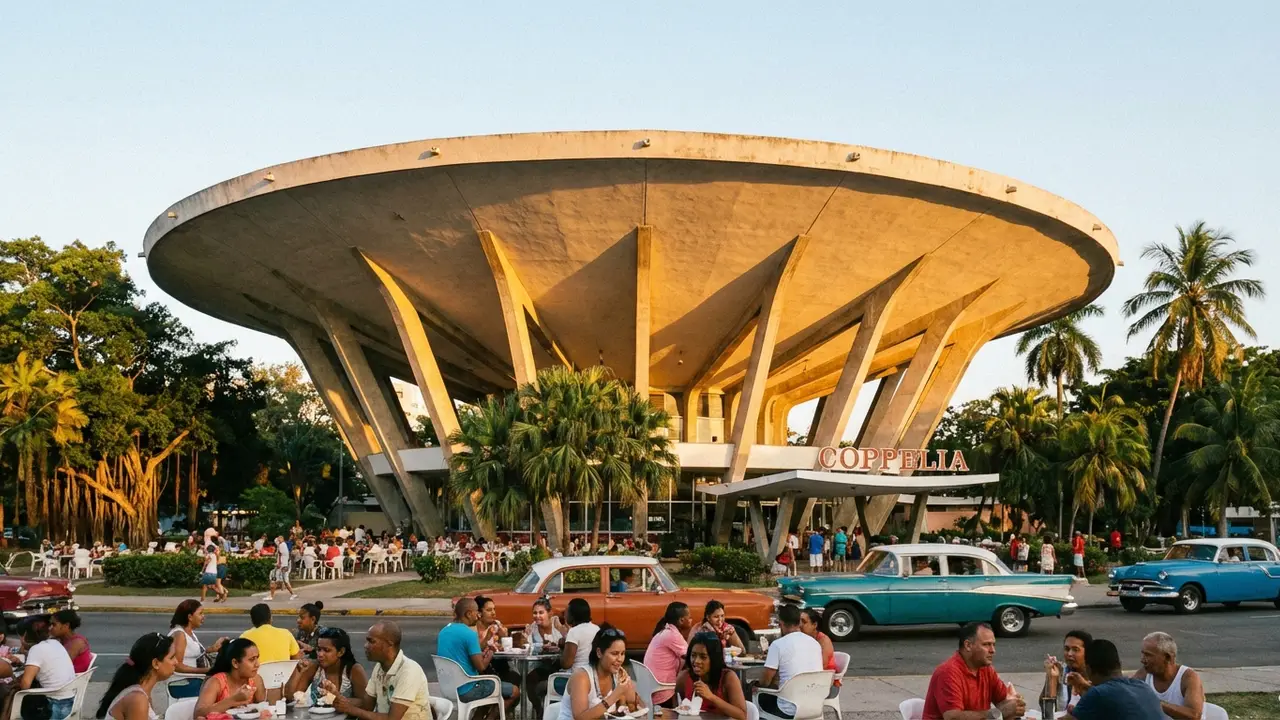
Illustration: Aroma de Cuba (AI)
There’s a place in Havana where time is measured in scoops and waiting in line is part of the ritual. Coppelia, Cuba’s most iconic ice cream parlor, isn’t just a business — it’s a cultural institution that has been sweetening Cuban life for nearly six decades.
Celia Sánchez’s Dream
The story of Coppelia begins with an obsession and a ballet. In the early years of the Revolution, Cuba set out to prove it could produce more ice cream flavors than the United States. Celia Sánchez, Fidel Castro’s personal secretary and one of the Revolution’s most influential figures, commissioned architect Mario Girona to design an ice cream parlor capable of serving 1,000 people simultaneously.
Sánchez named the project after her favorite ballet: Coppélia, Léo Delibes’ story of a doll that comes to life. And like the ballet, the building Girona designed seemed to have a life of its own.
On June 4, 1966, Coppelia opened its doors with 26 flavors and 25 combinations — numbers that, according to legend, paid tribute to the Moncada Barracks attack on July 26, 1953.
Architecture from Another Planet
Coppelia’s building is a masterpiece of Cuban revolutionary modernism. Designed by Mario Girona with Rita María Grau and Candelario Ajuria, the structure resembles a flying saucer nestled among tropical trees.
Five white granite discs connect to a grand helicoidal staircase, with wood and tinted glass panels, all beneath a massive circular roof supported by twelve reinforced concrete arachnid-shaped columns. The influence of Italy’s Pier Luigi Nervi, Mexico’s Félix Candela, and Brazil’s Oscar Niemeyer is evident in every curve.
The parlor occupies an entire city block in the heart of Vedado, between Calle 23 (La Rampa) and Calle 21. With seating for 547, it’s one of the largest ice cream parlors in the world.
Strawberry and Chocolate: Coppelia on Screen
If Coppelia was already legendary among Cubans, the film Strawberry and Chocolate (1993) elevated it to international cultural fame. Directed by Tomás Gutiérrez Alea and Juan Carlos Tabío, the film tells the unlikely friendship between David, a young communist militant, and Diego, a gay artist persecuted by the system.
The opening scene — where both characters meet in Coppelia’s dining rooms — turned the parlor into a symbol of encounter, tolerance, and dialogue in a complex Cuba. One of its salons still carries that cinematic aura today.
From 26 Flavors to One: The Crisis
For decades, Coppelia meant variety and accessibility. Havana families would queue on Sundays like going to church — hence the nickname “Cathedral of Ice Cream.” But Cuba’s history hit hard.
After the Soviet bloc collapsed in the 1990s, the Special Period devastated ice cream production. The 26 flavors dwindled gradually. By 2024, the situation was dire: Coppelia could barely offer a single flavor on many days. Refrigeration equipment failed, milk was scarce, and prices couldn’t cover production costs.
In November 2024, the parlor closed its doors for the first time in decades. The news shook Cubans like a bad omen — if Coppelia closed, what was left?
The 2025 Reopening
In February 2025, Coppelia rose again. After three months of closure to adjust prices and reorganize operations, the cathedral of ice cream reopened with more than 8 flavors and 14 combinations — far from the original 26, but a notable improvement.
The price of the classic five-scoop ensalada rose from 45 to 155 Cuban pesos (from $0.37 to approximately $1.29 USD). The ice cream maintains a 60% state subsidy, but in a country where the average salary is around $42 per month, even Coppelia becomes a luxury for many.
“Coppelia is open. What joy! Because this has become like a symbol of the country,” celebrated 82-year-old Víctor Montoya outside the parlor, as reported by AFP/RFI.
Private Competition
Since the expansion of Cuba’s private sector in 2021, dozens of independent ice cream shops have opened in Havana. Sabor Cid, for example, opened near Coppelia with 24 artisanal flavors made with Italian-imported ingredients. But a single cup there costs over $3 — an unattainable luxury for most Cubans.
Coppelia represents something private shops can’t replicate: popular accessibility. It’s ice cream for everyone, not just those with hard currency. That social mission, inherited from the project’s original ideals, remains its greatest differentiator.
Coppelia Across the Provinces
While the Vedado location is the most famous, Coppelia has branches in virtually every provincial capital in Cuba. Each has its own personality, but all share the brand and the mission of providing affordable ice cream to the Cuban people.
Legendary Flavors
In its prime, Coppelia’s menu included flavors that Cubans remember with deep nostalgia:
- Ubre Blanca — the star flavor, named after Cuba’s famous record-breaking dairy cow
- Fresa y Chocolate — the combination immortalized by the film
- Coco quemado — coconut with dark caramel
- Guanábana — fruity and tropical soursop
- Almendrado — with Cuban almonds
- Chocolate — the eternal classic
More Than Ice Cream
Coppelia was never just an ice cream parlor. It’s a meeting point, a salon for conversation, a stage for first dates, and a place for family reunions. Its shaded gardens, surrounded by tropical vegetation, offer relief from Havana’s heat and the frenetic pace of La Rampa.
For Cubans abroad, mentioning Coppelia conjures an entire emotional map: the line under the sun, the taste of ice cream on the tongue, the conversation that stretched between one scoop and the next.
The Cathedral’s Future
In 2026, Coppelia turns 60 years old — six decades of ice cream, lines, crises, and resilience. The parlor has promised to explore “new options” for this anniversary. If it can recover even a fraction of its legendary variety, it will be a small but symbolic victory in a Cuba that needs reasons to celebrate.
Because in the end, Coppelia is Cuba in ice cream form: sweet, resilient, imperfect, and absolutely irresistible.
Have you visited Coppelia? What was your favorite flavor? Tell us in the comments.
More Cuban products on Aroma de Cuba:
Frequently asked questions
What is Coppelia and why is it famous in Cuba?
How many flavors does Coppelia have now?
How much does ice cream cost at Coppelia?
Where is Coppelia located in Havana?
How we got here
Background
The first thing we published on this topic.
Old Havana Restoration Reaches a New Milestone
Rehabilitation work in the historic quarter reveals colonial frescoes from the 18th century.
Governments Issue Travel Warnings for Cuba Amid US Tensions
Canada, Argentina, Spain and other countries warn citizens about Cuba's crisis as Washington's oil blockade and prolonged blackouts affect the island.
Related articles
Art Deco Architecture in Havana: Hidden Gems from the 1930s
Discover Havana's most stunning Art Deco buildings, from the Bacardí Building to the América Theater — Cuba's overlooked architectural treasures.

Benny Moré: The Wildman of Rhythm Who Defined Cuban Music
Life and legacy of Benny Moré, Cuba's greatest singer. From the sugarcane fields of Lajas to conquering Havana and Mexico with his unique voice.

Havana's Salsa Festival Celebrates Orquesta Revé's 70th Anniversary
The 10th Festival de la Salsa honors a decade of music and 70 years of Elito Revé y su Charangón at Havana's Club 500.

Tropicana: The Paradise Under the Stars That Dazzled the World
The history of Havana's Tropicana cabaret from 1939 to today. Architecture, shows, and its enduring Cuban cultural legacy.
Abakuá: Cuba's Secret Afro-Cuban Society That Defied Slavery
History of the Abakuá secret society in Cuba, from the Ékpè of Calabar to the ñáñigos of Havana. Rituals, íremes, and cultural legacy.
Carlos Acosta Reinvents The Nutcracker with Cuban Flavor
The legendary Cuban dancer transforms the holiday classic with Nutcracker in Havana, fusing classical ballet with Afro-Cuban rhythms.