The Seven First Villas of Cuba: the Origin of a Nation
Between 1511 and 1515, Diego Velázquez founded seven villas that shaped Cuba. Discover the history of Baracoa, Bayamo, Trinidad and more.
5 min read
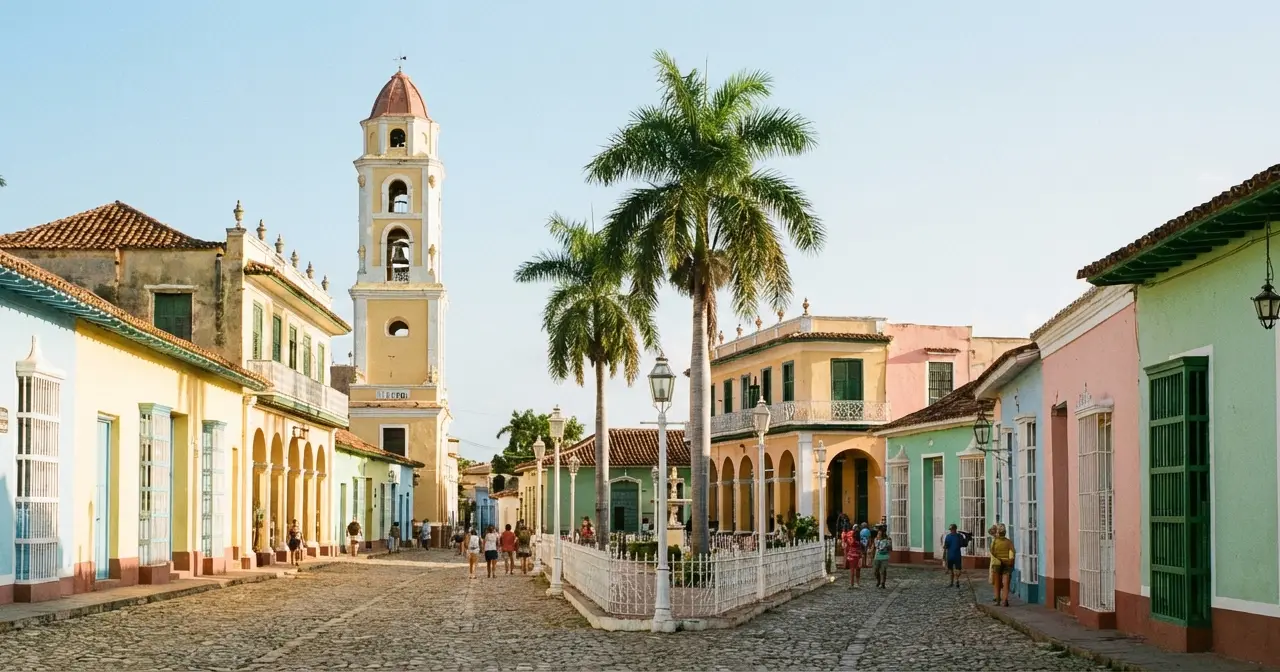
Illustration: Aroma de Cuba (AI)
Before Cuba was Cuba — before the son, the coffee, and the revolutions — there were seven towns. Seven villas founded by a Spanish conquistador who crossed the island from end to end, planting crosses and raising churches between 1511 and 1515.
Those seven villas didn’t just mark the birth of a colony. They were the seeds of a nation.
Diego Velázquez: the man behind the conquest
Diego Velázquez de Cuéllar was no newcomer when he arrived in Cuba. A veteran of the colonization of Hispaniola alongside Columbus, he had accumulated enough experience — and ambition — to lead the conquest of the Caribbean’s largest island.
In 1511, he departed from Salvatierra de la Sabana (in present-day Haiti) with some 300 men. His mission: to subdue the indigenous peoples and establish permanent settlements to serve as administrative, religious, and economic centers for the Spanish Crown.
What followed was a four-year journey that would forever reshape Cuba’s human geography.
The seven villas, one by one
1. Baracoa (1511) — The first city
Nuestra Señora de la Asunción de Baracoa was the first villa and first capital of Cuba. Nestled in the far east between mountains and sea, Baracoa retains a singular character to this day. Its parish church houses the Cruz de Parra, believed to be the only surviving cross of the 29 planted by Columbus in the Americas.
Indigenous resistance, led by the cacique Hatuey, was crushed here with brutal violence. Hatuey was burned at the stake in 1512, becoming Cuba’s first symbol of resistance.
2. Bayamo (1513) — Cradle of nationality
San Salvador de Bayamo, founded on November 5, 1513, would centuries later become the cradle of Cuban independence. Here the National Anthem was first sung in 1868, and here Carlos Manuel de Céspedes launched the first cry for freedom.
The people of Bayamo, rather than surrender their city to the enemy, chose to burn it entirely in January 1869 — an act of defiance that still defines the city’s character.
3. Trinidad (1514) — The colonial jewel
La Santísima Trinidad, founded in 1514, is today Cuba’s best-preserved colonial town and a UNESCO World Heritage Site since 1988. Its cobblestone streets, red-tiled roofs, and plazas surrounded by 19th-century mansions make it a living museum.
Trinidad prospered through the sugar industry and trade (smuggling included). The nearby Valley of the Sugar Mills stands as testament to that wealth — and to the slavery that made it possible.
4. Sancti Spíritus (1514) — The city on the Yayabo
Sancti Spíritus was founded in 1514, though it relocated in 1522 to the banks of the Yayabo River for better conditions. It’s famous for its bridge over the Yayabo, the only one of its kind surviving in Cuba, and for a legend: the guayabera shirt supposedly originated here, named for the guavas (guayabas) carried in its pockets.
5. Puerto Príncipe (1514) — Today’s Camagüey
Santa María del Puerto del Príncipe, now Camagüey, was founded in 1514 on the northern coast before moving inland. Its irregular maze of streets — designed, tradition holds, to confuse pirates — earned it World Heritage status in 2008.
Camagüey is also the city of tinajones, enormous clay jars once used to collect rainwater, now its most recognizable symbol.
6. Santiago de Cuba (1515) — The rebel capital
Santiago de Cuba, founded in 1515 likely under the oversight of Hernán Cortés (then its mayor), served as Cuba’s capital until 1589. Hero city, Caribbean capital, birthplace of son music and revolutions.
The Castillo de San Pedro de la Roca, a World Heritage Site, is the most complete example of Spanish-American military architecture from the 17th-18th centuries.
7. San Cristóbal de La Habana (1515) — Key to the New World
The last villa founded was San Cristóbal de La Habana in 1515, initially on the southern coast before settling at its current location beside the bay. Its strategic position made it the most important port of the Spanish empire in the Americas — the “Key to the New World,” as its coat of arms proclaims.
Old Havana was declared a World Heritage Site in 1982.
The human cost
The founding of the seven villas was no peaceful enterprise. Cuba’s Taíno and Siboney populations were decimated by direct violence, forced labor through the encomienda system, and diseases brought by Europeans. Within mere decades, the indigenous peoples had virtually disappeared as a distinct demographic group.
The encomienda system distributed indigenous people among settlers as forced labor. When the indigenous population dwindled, the Spanish turned to the African slave trade — opening another chapter of exploitation that would last centuries.
A legacy that endures
Five hundred years later, the seven original villas remain living cities. Four of them — Trinidad, Havana, Santiago de Cuba, and Camagüey — are World Heritage Sites. Baracoa keeps its magical isolation. Bayamo remains proud of its rebellion. Sancti Spíritus preserves its bridge and legends.
They are Cuba’s roots. Everything that followed — slavery, sugar, the wars of independence, the republic, the revolution — grew from the foundations Diego Velázquez planted between 1511 and 1515, never imagining the nation that would rise from those seven small villas.
Frequently asked questions
What are the seven first villas of Cuba?
Which was the first villa founded in Cuba?
Why did Diego Velázquez found the villas from east to west?
Which of the seven villas are UNESCO World Heritage Sites?
How we got here
Background
The first thing we published on this topic.
Old Havana Restoration Reaches a New Milestone
Rehabilitation work in the historic quarter reveals colonial frescoes from the 18th century.
Governments Issue Travel Warnings for Cuba Amid US Tensions
Canada, Argentina, Spain and other countries warn citizens about Cuba's crisis as Washington's oil blockade and prolonged blackouts affect the island.
Related articles
Trinidad, Cuba: The Time-Frozen City That Became a UNESCO Gem
Explore Trinidad, Cuba's best-preserved colonial city and UNESCO World Heritage Site since 1988. History, architecture, music, and the Sugar Mills Valley.
Trinidad, Cuba: essential guide to Cuba's most beautiful city
Complete guide to Trinidad, Cuba. What to see, where to stay, casas particulares, nearby beaches and tips to explore this UNESCO gem.
Havana's Chinatown: 179 Years of Cultural Legacy in Cuba
The world's second-largest Chinatown outside Asia was born in Cuba in 1847. Discover its remarkable history.
The Cuban Guayabera: History of the Shirt That Defines Cuba
From the Yayabo River to presidential summits: the guayabera was born peasant and became a symbol of Cuban elegance. Discover its history.
Santiago de Cuba: Birthplace of Son, Revolution and Caribbean
Complete guide to Santiago de Cuba: what to see, where to go, and how to experience Cuba's most Caribbean city. History, music, and beaches.
The USS Maine Explosion: the Sinking That Changed Cuba
On February 15, 1898, the battleship USS Maine exploded in Havana Harbor, triggering the Spanish-American War and reshaping Cuba's future.