Cuban Marabú Charcoal: From Invasive Plague to Premium Export
Discover how Cuba turns marabú, an invasive plant, into premium artisanal charcoal exported to Europe. History, production, and market.
5 min read
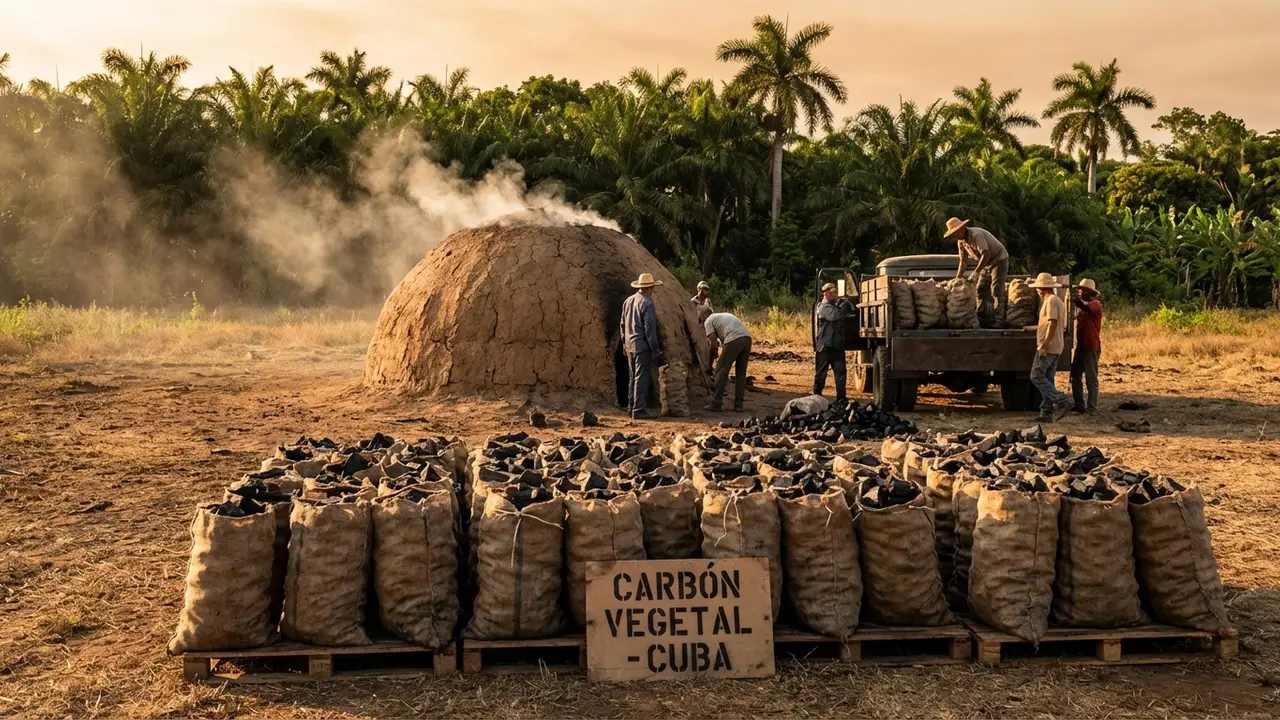
Illustration: Aroma de Cuba (AI)
Cuba’s green paradox
In Cuba’s countryside grows a silent enemy. Marabú (Dichrostachys cinerea) has invaded more than 1.5 million hectares of arable land, smothering the island in a thorny tangle that chokes crops and devours pasturelands. What was a curse for Cuban farmers for decades has become, by an irony of fate, one of the country’s most profitable export products.
Cuban marabú charcoal is now a premium item on European barbecues. From Berlin to London, discerning grillers pay top prices for this artisanal Caribbean charcoal that burns longer, produces less smoke, and respects the original flavor of meats.
A plant with a dark history
Marabú arrived in Cuba in the 19th century as an ornamental plant, likely brought from Africa. Nobody imagined this shrubby legume would become the island’s most destructive invasive species.
Its secret lies in its relentless biology:
- Grows up to 5 meters tall and forms impenetrable thickets
- Its roots are nearly impossible to fully eradicate
- Produces thousands of seeds spread by grazing cattle
- Resists drought, fire, and virtually every control method
During the Special Period of the 1990s, when Cuban agriculture collapsed after the fall of the Soviet Union, marabú advanced unchecked across abandoned lands. What were once sugarcane fields and pastures became forests of thorns.
From curse to business: artisanal charcoal
The solution emerged from necessity. Cuba’s carboneros — charcoal makers — discovered that marabú wood, extremely dense and hard, produced exceptionally high-quality charcoal.
The production process
Making marabú charcoal is an art passed down through generations:
- Cutting: Carboneros harvest marabú with machetes and chainsaws from invaded fields
- Stacking: The wood is carefully piled in rustic earthen kilns
- Carbonization: Heated to temperatures near 700°C in the absence of air over several days
- Cooling: The kiln is sealed and left to cool slowly
- Sorting: Charcoal is graded by size, packed in 20 kg bags, and shipped to processing centers
The main production centers are in Ciego de Ávila, Camagüey, Bayamo, and other areas in central-eastern Cuba where marabú infestation is most severe.
Agricultural cooperatives known as CCS (Credit and Services Cooperatives) organize most production, with thousands of farmers involved in the supply chain.
What makes marabú charcoal special?
The secret lies in the wood’s properties:
| Feature | Marabú charcoal | Conventional charcoal |
|---|---|---|
| Heat output | 7,000-7,500 kcal/kg | 5,000-6,000 kcal/kg |
| Burn time | 3-4 hours | 1.5-2 hours |
| Smoke production | Minimal | Moderate-high |
| Flavor alteration | None | Variable |
| Ash content | Low (3-5%) | High (8-15%) |
For barbecue and grilling enthusiasts, these numbers are no small matter. A charcoal that lasts twice as long, produces less smoke, and won’t contaminate the flavor of a fine cut of meat is, simply put, black gold.
It’s also widely used for shisha (hookah) in Middle Eastern and Turkish markets, where its clean, consistent burn is especially valued.
The international market
Cuba exports between 40,000 and 80,000 tons of charcoal annually, the vast majority from marabú. The main destinations are:
- 🇩🇪 Germany — Europe’s largest importer
- 🇬🇧 United Kingdom — premium BBQ market
- 🇮🇹 Italy — restaurants and pizzerias
- 🇹🇷 Turkey — shisha and mangal market
- 🇪🇸 Spain — parrillas and steakhouses
Companies like Alcarbon S.A. operate as specialized intermediaries, supervising quality from Cuba to the European port of destination.
The historic US milestone
In January 2017, marabú charcoal made history as the first Cuban export to the United States since the embargo was imposed in 1960. The state-owned company Cubaexport shipped two 20-ton containers to the American firm Coabana Trading, marking a symbolic moment in bilateral trade relations.
The double ecological benefit
What makes marabú charcoal particularly attractive in the age of sustainability is its dual positive impact:
- Removes an invasive species: Every ton of charcoal produced frees Cuban land from the marabú plague, returning hectares to agricultural use
- Prevents deforestation: Unlike traditional charcoal, it doesn’t require logging native forests or valuable species
This ecological argument has resonated especially in the European market, where consumers increasingly demand products with verifiable environmental credentials.
However, the industry is not without controversy. Recent reports have raised concerns about difficult working conditions for charcoal makers, and international organizations have called for greater transparency in the production chain.
How to identify authentic marabú charcoal
If you find marabú charcoal at a specialty store or online, here are the signs of authenticity:
- Intense black color with a metallic sheen
- Heavy for its size (high density)
- Metallic ring when pieces are tapped together
- Origin: Cuba clearly labeled on the packaging
- Irregular pieces 5 to 15 cm long (not uniform briquettes)
In Europe, brands like Alcarbon, CubaCoal, and distributors like Dankar Trade sell the product. On Amazon and specialty BBQ stores it can also be found, typically at a premium over conventional charcoal.
Marabú in Cuban culture
Beyond commerce, marabú is part of Cuba’s cultural landscape. The popular saying “eso está lleno de marabú” (that’s full of marabú) is used to describe any abandoned or out-of-control situation. The shrub appears in peasant songs, literature, and even political discourse as a symbol of the land Cuba needs to reclaim.
The carboneros themselves are recognized figures in rural Cuba: sun- and smoke-weathered men who master an ancestral craft passed from father to son.
A Cuban product with a future
Marabú charcoal represents one of those rare stories where adversity transforms into opportunity. Cuba has enough marabú for decades of production — some estimates suggest the plant covers between 30% and 50% of the country’s agricultural land.
With growing global demand for premium grilling charcoal, the expanding shisha market, and increasing value placed on sustainable products, the future of Cuban marabú charcoal looks secure. It is, quite literally, turning a plague into black gold.
Interested in Cuban gastronomy? Learn more about essential Cuban seasonings and guarapo, the island’s most refreshing drink.
Frequently asked questions
What is Cuban marabú charcoal?
Why is marabú charcoal so popular for grilling?
Which countries import Cuban marabú charcoal?
Is marabú charcoal production sustainable?
How we got here
Background
The first thing we published on this topic.
Habanos: Complete Guide to the Most Prestigious Cuban Cigars
Cohiba, Montecristo, Romeo y Julieta — discover the legendary Cuban cigar brands, how to choose them, and where to buy them.
Cuban Rum: Complete Guide to Brands, History, and How to Enjoy It
Discover the world of Cuban rum: from Havana Club to Santiago de Cuba. History, legendary brands, aging types, and secrets to tasting it like an expert.
Related articles
Marabu Charcoal: Cuba's Black Gold Conquering the World
Discover Cuban marabu charcoal, from invasive plant to gourmet product exported to Europe and the US. History, production, and where to buy it.
Cuban Medicinal Plants: A Guide to Cuba's Green Medicine Tradition
Discover Cuba's most popular medicinal plants, from aloe vera to lemongrass. History, uses, and traditions of Cuban green medicine.
Cuban Casabe: The Ancient Taíno Cassava Bread, UNESCO Heritage
Complete guide to Cuban casabe, the cassava flatbread inherited from the Taínos. History, preparation, UNESCO 2024 recognition, and where to buy.
The Cuban Guayabera: History, Style & Tropical Elegance
Discover the Cuban guayabera, the Caribbean's most iconic shirt. Its history from Sancti Spíritus, features, how to choose one, and where to buy.
Cuban Peanut Turrón: The Beloved Street Sweet You Need to Try
Discover turrón de maní, Cuba's iconic peanut nougat. History, traditional 2-ingredient recipe, and where to buy it.
Yarey Hat: Cuba's Iconic Countryside Symbol and National Heritage
Discover the Cuban yarey hat, an intangible national heritage. History, artisanal craft process, origins in Camajuaní, and where to buy one.